



From the floatplane, reddish-brown kelp traces the edges of the small islands between Ketchikan and Prince of Wales Island like brushstrokes on the surface of the water. Up close, on a rare 70-degree July day in Alaska, the kelp is glossy and beautiful, though the wind coming off the water makes it nearly impossible to hold steady. Fresh giant kelp is all glimmer and shine, and under ideal conditions it can grow up to two feet in a single day. But pull it from the water and leave it outside, Pacific Kelp Co. co-founder John Smet explains, and within hours it can shrink to a fraction of its size and become brittle enough to snap between your fingers.
The quick transformation is a reminder of how recently the kelp was growing and of a practical challenge facing Alaska’s young kelp industry: Once it is harvested, what happens next?
Smet and co-founder Nick Stern are trying to answer that question. The friends met at Cornell University, worked in corporate jobs, then moved to Southeast Alaska to build a company around giant kelp. At first, they thought they would focus mainly on farming it. “The problem that needed to be solved in the industry is we have all this kelp,” Smet says. “What do we do with it now?”
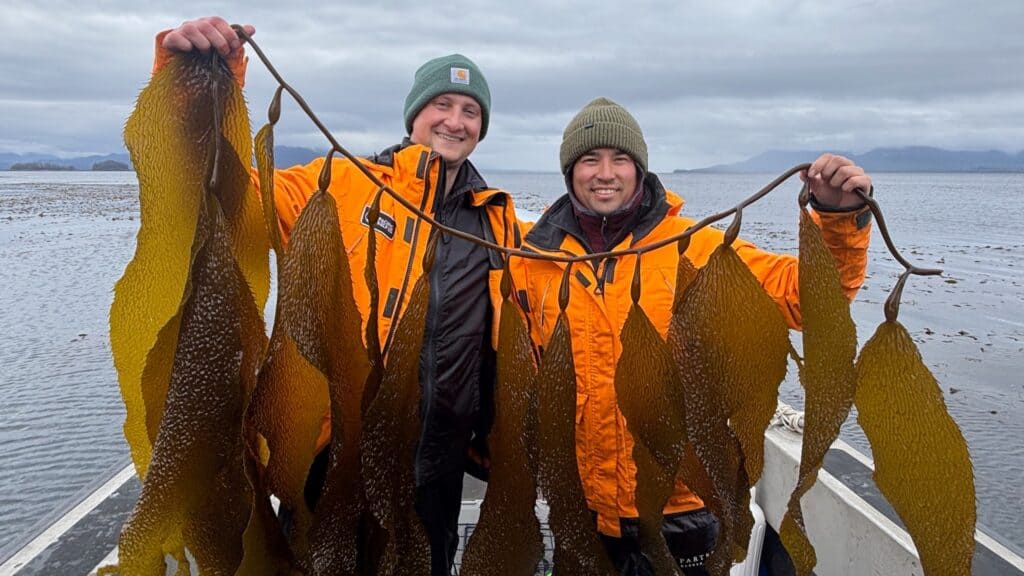
Pacific Kelp Co. founders John Smet, left, and Nick Stern harvest giant kelp by trimming its floating canopy, a process they call “giving it a haircut.”
Courtesy of Pacific Kelp Co.
Their answer is KelpEdge, a concentrated liquid plant biostimulant made from Alaskan giant kelp. Inside their processing facility, the long blades are shredded, blended with water into something resembling a green smoothie, and put through a cold extraction process designed to break open the kelp’s cell walls. A centrifuge then separates the liquid concentrate, which becomes KelpEdge, from a fibrous byproduct.
Liquid seaweed products are not new to agriculture; growers have applied them to soil and leaves for decades. KelpEdge isn’t meant to replace fertilizer—Smet describes it as a supplement that may support stronger roots and help crops better withstand heat, drought, and disease pressure. Pacific Kelp sells the concentrate in small bottles for houseplants, available through the company’s website and Amazon, and in bulk containers for commercial growers. “Anybody that grows anything,” Smet says, could potentially use it.
Pacific Kelp is collaborating with Washington State University scientists to study the extract’s effects on different crops. Through work with WSU grapevine physiologist Bhaskar Bondada, researchers are testing kelp-based biostimulants in Napa vineyards, looking at soil health, grape quality, and whether treated vines can better withstand reduced irrigation. Smet says WSU researchers are also testing a Pacific Kelp extract as one possible tool for helping Washington raspberries withstand heat stress.
The Evergreen State produces about 95% of the nation’s processed red raspberries, a crop traditionally suited to the region’s mild summers. During the 2021 Pacific Northwest heat dome, Washington raspberry growers reported an estimated 30% yield loss, while combined losses to the region’s raspberry and blackberry industries exceeded $45 million.
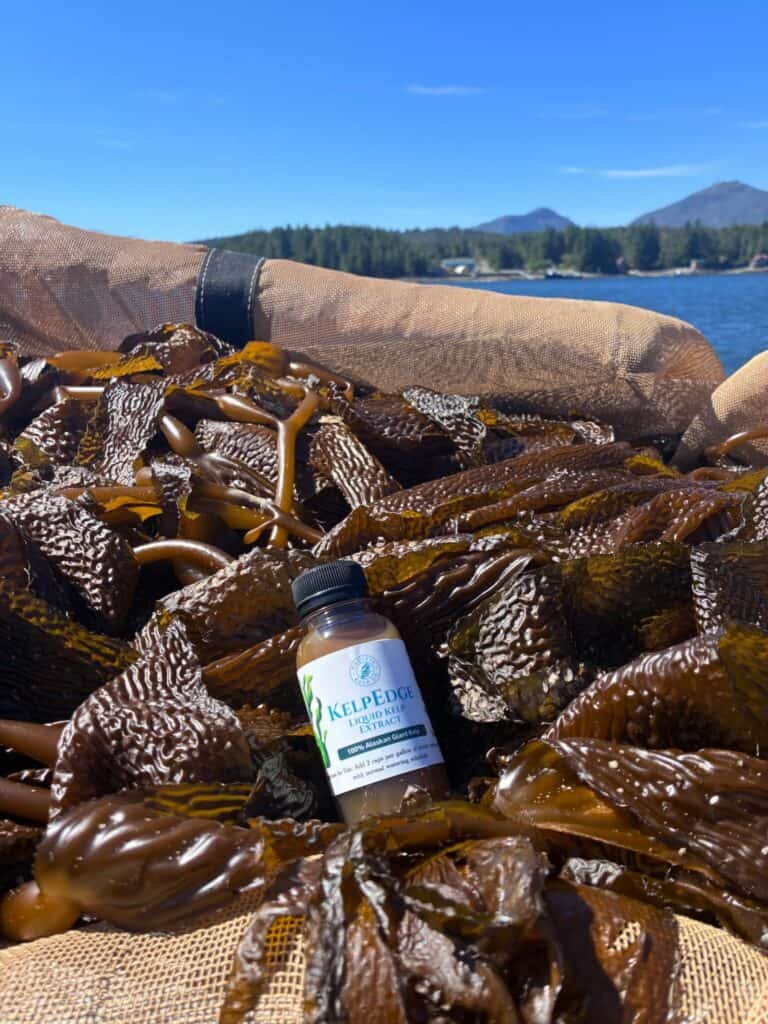
Pacific Kelp sells KelpEdge in sizes ranging from small bottles for home gardeners to bulk containers for commercial growers.
Photo by Sarah Stackhouse
For Smet, independent studies are essential because growers need to know that adding another expense will deliver a worthwhile result. “Why would I spend an extra 10 bucks, 15 bucks an acre if I’m not 100% confident that it’s going to do what I expect it to do?” he says. Trials allow farmers to see what was tested and whether the potential improvement justifies the cost. They also help answer growers’ basic questions about kelp. “The vast majority of people that are growing are not aware of kelp products and are not using them,” Smet says.
Back in Alaska, conditions are well suited to growing kelp. Glacial runoff and snowmelt feed nutrients into the state’s cold coastal waters, while long summer days provide plenty of light. The industry has grown quickly—the state’s first commercial harvest was in 2017, and by 2025, the harvest had reached more than 344,000 pounds, with more than 20 farms operating around the state.
Wildfire season has once again arrived in Washington, while heat and drought put pressure on growers here and around the world. As global warming intensifies those conditions, the possibility that kelp could help plants better tolerate drought is increasingly compelling. Whether KelpEdge can deliver those benefits consistently, and at a price growers are willing to pay, is still being tested. If it can, one tool for hotter, drier seasons may begin in the cold waters off Ketchikan.