



The funding was led by ANZ VC Blackbird, with GD1 and Rypples joining the cap table alongside existing investors K1W1, Icehouse Ventures, Shasta Ventures, NZVC and existing angel investors.
The funding is to ramp up production of Vessev’s VS-9 and VS-12 vessels, expand the company’s global go-to-market team and further work on its onboard software and telemetry platform.
The Vessev ferries are fully electric hydrofoiling passenger vessels providing using carbon fibre foils to lift the hull above the water, reducing drag and wake.
The VS–9 can carry 10 passengers at a 25-knot (46kmh) cruising speed, with a range of 50 nautical miles (93km).
The VS–12 will have capacity for up to 30 passengers and is still under development.
Vessev now has 58 staff in Auckland, and hopes to produced a VS–9 every five weeks in 2027.
Vessev has a deal to deliver VS–12 vessels into Sydney to support a future water transport network on the harbour.
In Perth, VS–9 vessels are expected to operate on the Swan River in 2027.
In Hobart, Fly Derwent has just doubled its order to 10 vessels and is working with the company on Vessev vessel manufacturing in Tasmania.
Vessev’s also cracked its first US customer, with demonstrations on Lake Tahoe, California, later this year.
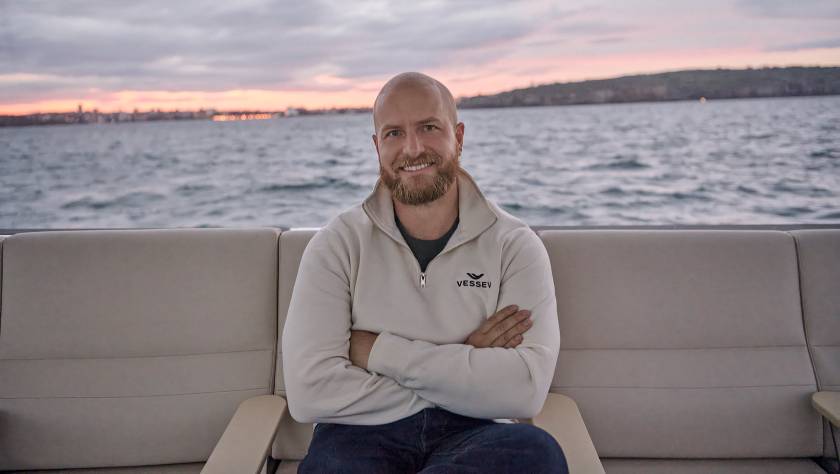
Aucklander Max Olson and Seattle-born Eric Laakmann founded Vessev in 2017, launching the VS-9 in 2024.
Olson, the CTO, previously cofounded Blackbird-backed agtech unicorn Halter, while Laakmann, the CEO, sailed 30,000 nautical miles to New Zealand, after a career as an Apple engineering lead, launching three generations of the Apple Watch.
Laakmann said Australia is one of the most exciting markets for electric hydrofoiling and a natural proving grown for Vessev’s aquatic technology.
“Australia currently has more planned electric hydrofoiling transport networks than any other country. Its cities are built around waterways that are still underused as transport corridors and we’re seeing strong demand for a new kind of water transport that is quiet, efficient, sustainable and commercially practical,” he said.
“This funding allows us to scale production and continue building the vessels and technology needed to get there faster.”
Fly Derwent principal Cameron McCulloch said they’re looking to connect more communities in Hobart and support tourism.
“We want to position Tasmania as a global leader in low-impact transport, built on its renewable energy advantage,” he said.
“We’re currently raising additional capital, with interest from investors, communities, developers and businesses who all see ways to build Fly Derwent into their broader plans.”
Blackbird partner Phoebe Harrop Meadows said the marine technology startup is the latest example of Kiwi ingenuity.
“Vessev is bringing world-class engineering from Apple, Tesla, the America’s Cup and Rocket Lab to a massive, long-stagnant industry,” he said.
“Its combination of foiling technology and software can lower operating costs while improving the passenger experience, showing how waterways can function as near-zero-emission transport networks in Australia and beyond.”