



We were drafting poetry, and I pulled out and played with a line I heard in a near-end-game section of Final Fantasy X. “Will humanity ever attain such purity?” Lady Yunalesca asks the party, invoking an existential debate on human nature and atonement.
Despite it being a somewhat foundational moment for discovering my own voice as a writer, it was both the first and last time that I’d use a videogame as writing inspiration in school. I fell into the belief that videogames were not accepted literary material. A view that, had I expressed it to my teachers at the time, would have been reinforced.
But a lot can change over a decade.
Anyone who plays games regularly knows that they are a vehicle for big ideas. Examples abound. Last year’s Game of the Year, Clair Obscur: Expedition 33, explored themes of grief. Years ago, BioShock broke the internet with the philosophical debate around free will, inspired by its pivotal plot twist.
The learning goes beyond English essay topics, too. Anyone who’s played Age of Mythology or Age of Empires likely has a well-informed view on history and ancient cultures. There’s an abundance of memes on the internet regarding Assassin’s Creed players “revisiting” historical sites that they first experienced in-game. I have a friend whose career in urban planning was inspired by a love for SimCity.
Two University of Sydney academics, Associate Professor Jen Scott Curwood and Professor Marcus Carter, are attempting to change broader attitudes in this regard. And, in turn, introduce more videogames as material for lessons, both at a school and university level.
They’ve recently launched Ludolio, a Steam-like game platform that allows for the educational borrowing of games. It solves the main challenge with bringing games into the classroom: distribution.
Accessing a game for learning purposes isn’t as simple as accessing a book or movie. Curwood and Carter learned this the hard way a few years ago, when attempting to introduce a game, Night in the Woods, to a Year 7 class for a research project.
Many students had problems accessing itch.io — a game distribution platform — as it wasn’t approved by the school’s technology systems. “The developers very kindly gave us 200 itch codes. And they were just immediately lost to the wind,” Carter said.
Itch.io isn’t really fit for purpose either. It plays host to a number of titles that may not make it onto Steam due to explicit themes.
Curwood added: “One of the primary barriers to game-based learning is infrastructure. And that would never be acceptable if we were talking about other media, like books or films.”
“We would never say, ‘Oh, sorry kids, we just can’t get the books,’ or ‘You’ve got to see what free books you can get from Google.’”
Beyond this, the pair realised that the cost of having games in the classroom could also kneecap their goals. “$30 a game for every student every year is prohibitively expensive,” Carter said. “That’s in the order of four or five times more expensive than teaching a book.”
So, off the back of this research, Ludolio was designed to solve both challenges, integrating with a school’s technology stack and making it free for students to access for learning purposes. Similar to how Kanopy solved this issue for film, and OverDrive for books.
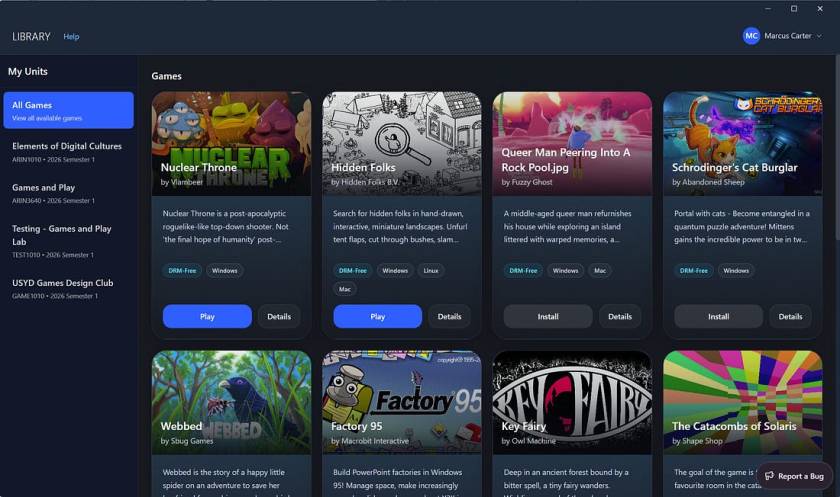
The platform is launching with 20 titles and a goal of getting over 100 on the platform before the end of next year.
It’s attempting to overcome a classic marketplace chicken-and-egg situation: it needs more titles to encourage interest from educators, and more schools and universities to coax further participation from the games industry.
Carter’s pitch to game developers? Not only has it been built to make it easy to upload and tweak games for Ludolio, but it can serve as a way to monetise their back catalogue or older titles. Launch your game on Steam, then, when sales start to dip, put it on Ludolio to give it a second life as an educational tool.
“Once a teacher develops a curriculum around a game, they’re not going to change that curriculum for five years,” he said.
“Game developers deserve to be able to make sustainable revenue from this the same way that a book author can pay off their house once their book is added to the New South Wales curriculum.”
Curwood and Carter are still considering Ludolio’s commercials for the platform. For now, it functions similarly to Xbox’s Game Pass in that the institution’s library pays a fixed price for access to the catalogue.
Developers currently split 70% of Ludolio’s revenue equally between them, with the platform keeping the remaining 30%. That split will remain, but Carter said the developers’ share may eventually be divided by usage. So, the more a game is played, the bigger its cut.
As for what works best, Carter said teachers prefer shorter games, but the platform casts a broad net across subjects. For instance, a lecturer in quantum computing is exploring whether he can use Schrödinger’s Cat Burglar as an opportunity to teach core concepts such as superpositionality.
But over time, Carter could see a world where games that are shorter than two hours — ones that generally don’t succeed on Steam, as players can fully refund games they’ve played for less than two hours — could find a home on Ludolio.
Carter also expects the platform to largely deal with smaller narrative or artistic indie games, as opposed to striking deals with larger publishers. “I always have to explain to people: we’re not talking about giving teenagers access to Grand Theft Auto here,” he said.
“The earlier we get games into the curriculum in this critical, analytical context, the better games we’re going to get in 10, 20 years,” he added.
Though that is easier said than done.
Currently, Ludolio’s adoption has broadly been contained to universities. This is no accident: there’s less bureaucracy involved in adjusting a university unit than adopting a new technology across the school system.
Case in point: in the same month that Ludolio publicly launched its platform, the New South Wales government announced a cap on screen time in schools, a policy criticised by both Curwood and Carter.
But, broadly speaking, the pair are optimistic about Ludolio’s adoption among school teachers. Their current focus is on independent schools, as Australia’s state-based education system serves as another barrier to Ludolio’s broader adoption within public schools.
Curwood, as a former English teacher, sees a lot of value in the medium as a teaching tool. Especially given that games are purposefully designed to encourage player engagement.
“I never assigned a book like Lord of the Flies and had two-thirds of the students come back the next day and say, ‘Oh, Miss, I’ve read the whole book,’” she said. But the pair have seen this enthusiasm when working with games.
Keeping on that contrast to books, Ludolio’s platform can also tell teachers — based on in-game player achievements — exactly how far a student is in a game, and whether they’ve actually started playing it. Information they often can’t glean when assigning books.
“What persuades a teacher to extend their practice or adopt new strategies isn’t me coming in with letters after my name saying, ‘Do this, because our research says it’s best,’” Curwood said. “It’s hearing from their colleagues.”
Change, however, may quietly already be in train, spurred on by students rather than the education system itself. Curwood said New South Wales HSC English leaves room for students to choose their own related texts, and she has known students who have opted for games.
“I think it’s just a way to engage young people in a new and compelling way, and to capitalise on some of the literacies they already have,” she said.
Somewhere, a Year 12 student could be quoting a videogame in their exam essay. I just hope they’re not embarrassed about it.
What do you think about seeing indie games used as educational tools? And do you have any good examples of how games shaped your learning? I’d love to hear them. Let me know in the comments.
- Harrison Polites writes the Infinite Lives newsletter. Follow him here.