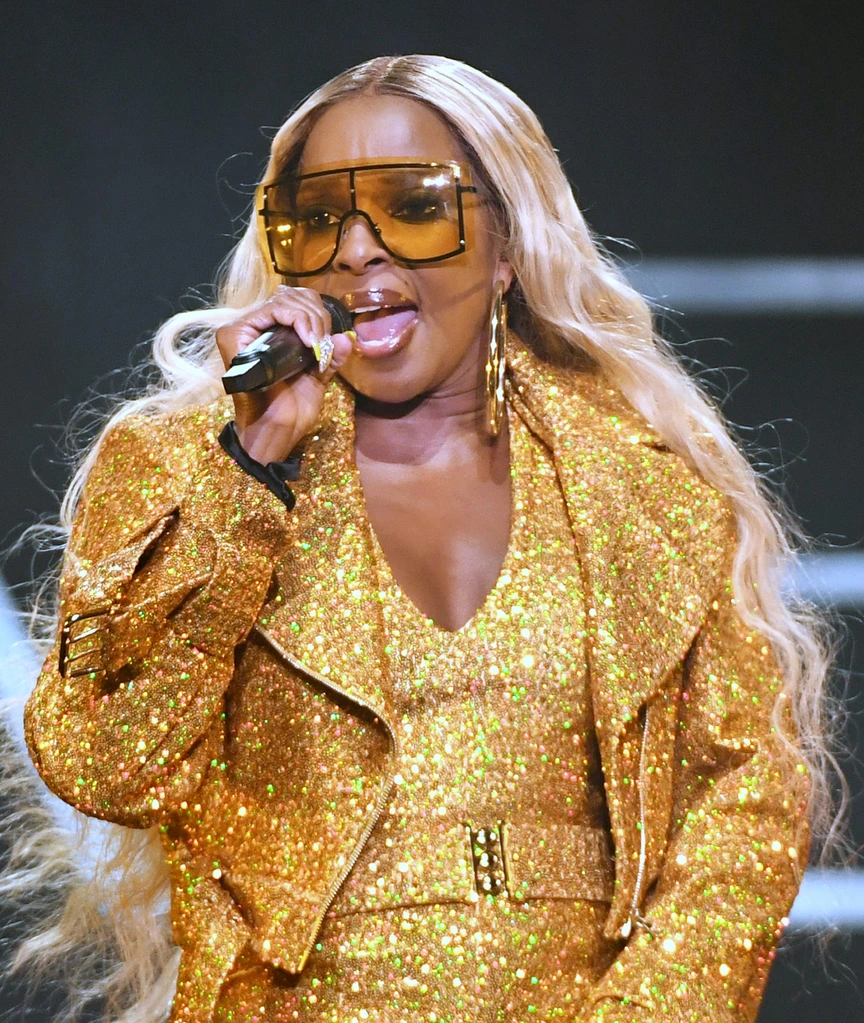



When I consider the most iconic fashion moments in music, I think of Lil’ Kim’s purple pasty ensemble (and other monochromatic looks), Missy Elliott’s inflatable trash bag suit, Salt-N-Pepa’s matching kufis paired with spandex bodysuits, and TLC’s fishnet tops that spell out the band name. Black female hip-hop artists take fashion risks when others won’t, and continue to innovate when other artists imitate (or as Lil’ Kim put it: “I used to wear Moschino, but every bitch got it / Now I rock colorful minks because my pockets stay knotted”). The Museum of Pop Culture’s newest exhibit, Styled by the Streets: Black Women in Hip-Hop Fashion, celebrates this history of innovation in a showcase of over thirty artifacts—hair pieces, nails, clothing, grillz, accessories—worn by performers like Mary J. Blige, Lil’ Kim, Cardi B, and Doja Cat, focusing on the bold experimentation of early aughts stars. “Black women are not footnotes in fashion history,” the exhibit states. “They are the blueprint.”
Though compact, Styled by the Streets covers over 40 years of fashion history. Walking into the exhibition, a showroom encased in a shell of pink enamel, the visitor is greeted with the gold motorcycle jacket and matching bodysuit Mary J. Blige wore in a 2016 Hard Rock Cafe appearance. While this particular outfit might not be immediately recognizable, it consumed the room with its iridescent twinkle. Flanking it are two other ensembles: a spiky pleather top worn by Doja Cat for her 2019 PAPER Magazine photoshoot and a purple fringe bodysuit worn by Cardi B on her Femme It Forward tour.

From across the room, I saw the wigs. That is, Lil’ Kim’s wigs. I knew her blonde Greek key-patterned wig would be present, but I was not expecting the turquoise Chanel logo wig (recreated by Beyoncé) to be there too. I was completely starstruck. Both were created by hairdresser Dionne Alexander, who made many of Lil’ Kim’s wigs, as well as styles for Mary J. Blige, Lauryn Hill, Missy Elliot, and Aretha Franklin.

Part of why I love MOPOP (which I stubbornly still call the EMP) is how the exhibitions are an entry point not just to history and artistry, but to the personal and collective memory embedded in the artifacts—the aura. I’ve been fawning over images of Lil’ Kim’s wigs my entire life; standing in front of them is the closest thing to standing in front of Lil’ Kim in the ’90s. These artifacts are the closest thing we have to time travel.
There is no arguing that Black women have shaped the visual language of hip-hop and made self-expression a form of power—the exhibit highlights coffin nails, grillz, and Jordans as key examples. “We want to make sure people understand that these items are museum-worthy, and challenge what has been traditionally considered to be put in museums,” MOPOP CEO Michele Y. Smith tells me over the phone. “These pieces are part of the story of hip-hop.”

Nail art has become increasingly popular among celebrities, with Temeka Jackson as the go-to manicurist for red carpet events and flashy outings (did you see the custom Edward Scissorhands nails she made for Saweetie’s Halloween last year!?) The exhibit houses two of Jackson’s sets displayed on lifelike hand mannequins: one set with a French tip called Fierce, Classy Claws and another, long and gilded with charms hanging on their tips, called Curved ’90s-2000s Auntie Nails. Alongside them was a stunning set of pink and blue coffin-shaped nails by local Seattle nail artist Ukeme Ekpoh, titled Threads of Her Becoming, inspired by Y2K nail trends. Beside the nails were grillz crafted by Ariel Nazira Jones for Melz Grilz Inc. One pair outlined in gold and platinum, then set with diamonds, while another alternated between painted stripes and colored stones—no two teeth were the same. The artistry of these pieces can’t be overstated. “I think a lot of people haven’t been able to see what a grill actually looks like,” says Smith.

The exhibition also packs some sobering reminders of how retrograde cultural gatekeepers can be, noting that Cardi B was the first female rapper to grace the cover of Vogue US—in 2019. Major publications haven’t historically credited Black women in hip-hop for their invaluable impact on fashion, but back in the ’90s, smaller magazines like Honey—largely regarded as the premier publication for Black women’s lifestyle and fashion, with a feminist, hip-hop edge—did. The exhibit includes spreads from those issues, like the “Smells Like Queen Spirit” spread featuring Lil’ Kim and cover stars Mary J. Blige and Amanda Lewis. While poring over these archives, I had to physically resist the urge to search for issues of Honey on eBay from my phone. “We had some clients here from Atlanta just the other day touring the exhibit, and she was like, ‘I remember this!’” Smith recalls. “It brought her back to being a teenager when that magazine was out. The exhibit did exactly what we wanted it to do.”
Styled by the Streets does more than tap into MOPOP’s ability to transport viewers through time, delivering a satisfying boost of nostalgia. It reveals the lineage of trends and culture, and honors the innovators who were bold enough to try something new.
Styled by the Streets: Black Women in Hip-Hop Fashion is on view now at the Museum of Pop Culture.