



Each fall, chum salmon, fresh from Puget Sound, muscle their way up Piper’s Creek to spawn, pushing through shallow riffles, around fallen branches and over gravel bars in a final journey that can bring wild salmon within a few feet of visitors. For several weeks in November and December, the park becomes one of the best places in the city to witness the salmon life cycle in action.
That alone would make the 220-acre park in northwest Seattle worth a visit. But there’s so much more to explore beyond the salmon run. Within a relatively compact landscape, the park combines a driftwood-strewn Puget Sound beach, wetlands, salmon-bearing streams and miles of wooded trails winding beneath Douglas fir, western red cedar and bigleaf maple.
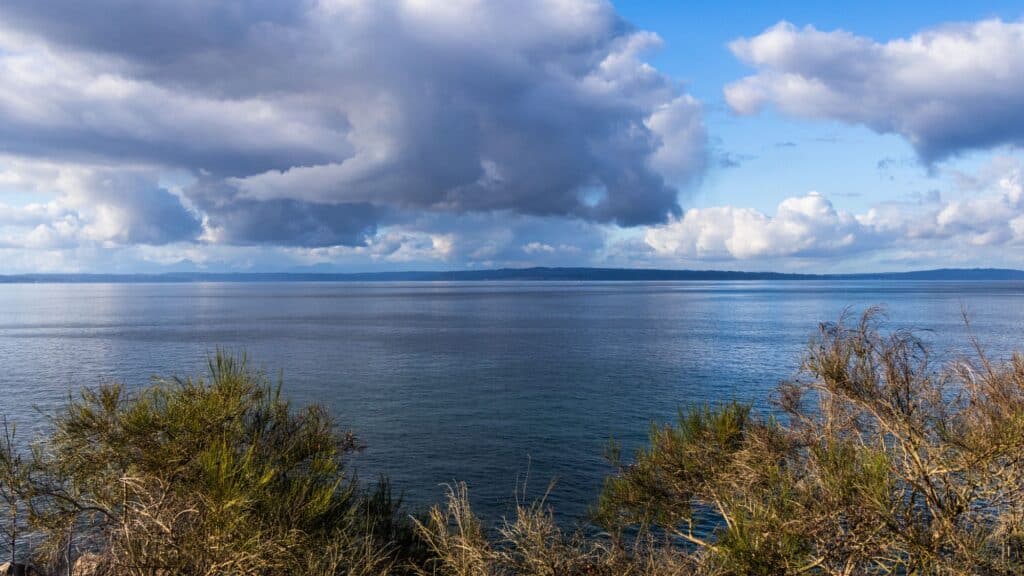
Carkeek Park’s beach looks out over Puget Sound, with the Olympic Mountains rising in the distance on clear days.
Photo by Roddy Scheer
Still, during the late-fall chum run, Piper’s Creek takes center stage.
After spending years in the North Pacific, adult chum return to freshwater to reproduce. Their bodies change dramatically as they enter the creek, with males developing hooked jaws and bold bands of purple, green and black. Females search out suitable gravel, then use their tails to excavate nests, called redds, where they deposit their eggs. Males fertilize the eggs, and both adults die soon after spawning. Seen up close, the process is anything but serene. Salmon may repeatedly lunge against the current, rest in pools, then surge forward again. A fish can appear exhausted one moment and suddenly power several feet upstream the next.
The run also reveals just how closely connected the region’s forests are to the sea. Salmon returning from the ocean bring marine nutrients into freshwater ecosystems. After spawning, their carcasses are consumed by birds, raccoons and other animals, while nutrients eventually enter the soil and surrounding vegetation. In this way, salmon quite literally help nourish the forest through which their streams flow.
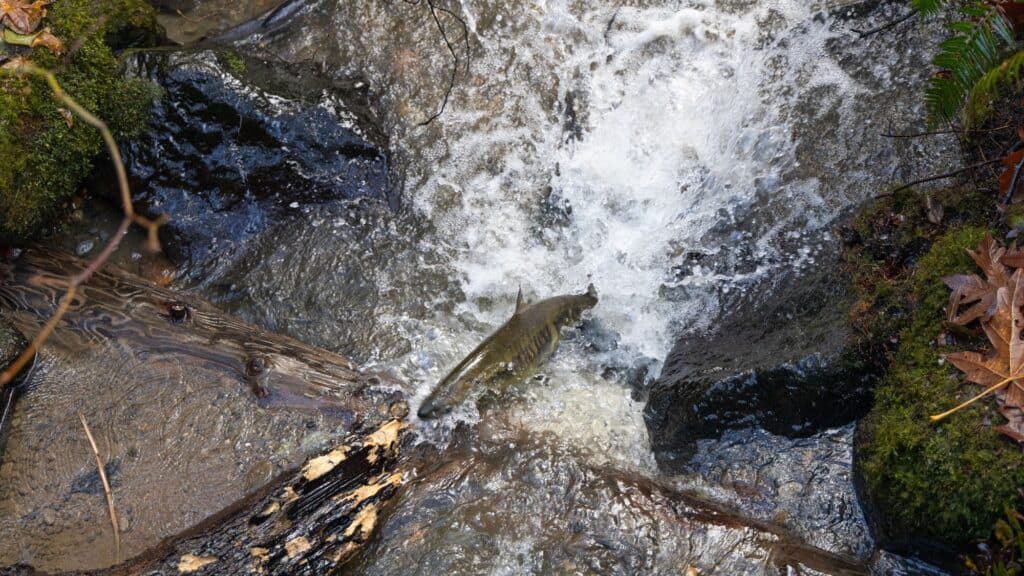
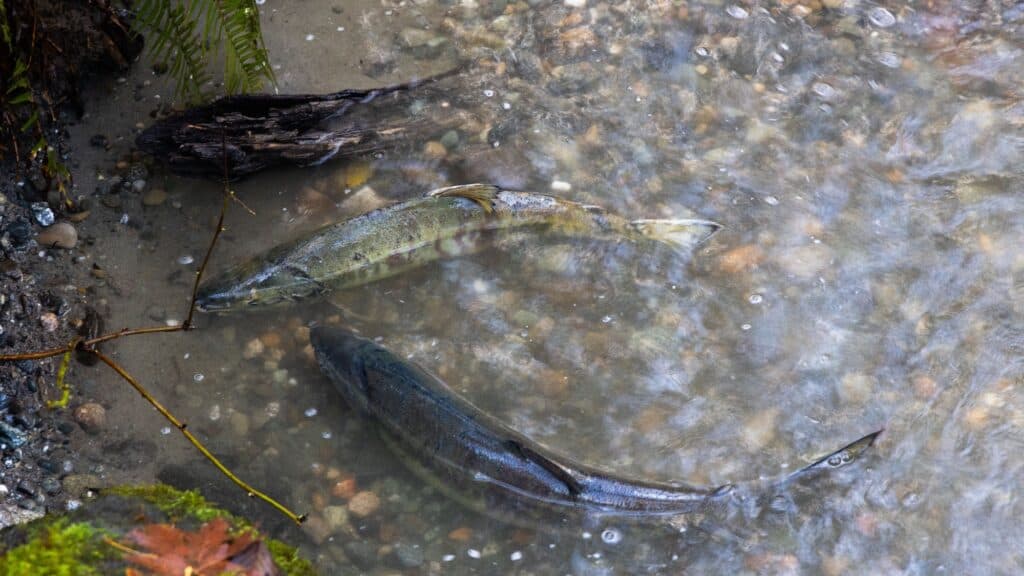
Two chum salmon make their way through the shallow, gravel-bottomed waters of Piper’s Creek.
Photos by Roddy Scheer
Piper’s Creek has also become a showcase for urban ecological restoration. Decades of community work have focused on improving stream habitat, removing invasive vegetation and restoring native plants along the creek corridor. Red alder, willow, salmonberry and other riparian vegetation help shade the water and provide cover and habitat for aquatic life. It’s a reminder that even in the middle of a major city, wild processes can continue to unfold.
Beyond the salmon run, the park’s trail system climbs into forest where sword fern, salal and Oregon grape fill the understory. Pacific wrens chatter from dense vegetation, chickadees move through the canopy and woodpeckers work the trunks of mature trees. In wetter areas, skunk cabbage and other moisture-loving plants mark the park’s lowlands.
Follow the creek downstream and the forest eventually opens onto Puget Sound. At low tide, the beach reveals barnacles, mussels, small crabs and other intertidal life, while harbor seals sometimes surface offshore. Bald eagles and other raptors patrol the shoreline, and on clear days the Olympic Mountains rise dramatically across the water.
Within a single outing, visitors can follow a salmon stream through shaded forest, cross wetlands and emerge onto a saltwater beach facing one of the grandest views in the city.
But in late fall, it is worth slowing down beside Piper’s Creek.
Watch the water carefully. What first looks like a submerged branch may suddenly move. A dark shape shifts against the current, a tail breaks the surface, and another chum salmon begins its next push upstream.
For a few weeks each year, one of nature’s oldest migrations passes directly through the city—and Carkeek Park offers a front-row seat.
When to Go
Chum salmon typically return to Piper’s Creek in November and December, with timing and numbers varying from year to year depending on rainfall and stream conditions.
Where to Look
Head to Carkeek Park in northwest Seattle and follow the trails along Piper’s Creek. Look for deeper pools, gravelly stretches and shallow riffles where salmon pause, spawn or work their way upstream. Move slowly, stay out of the creek and avoid disturbing fish or spawning beds.