



Kelly goto’s superbly crafted book, Seattle Samurai: A Cartoonist’s Perspective of the Japanese American Experience, is a heartfelt tribute to her late father, Sam Goto, whose long-running comic series, Seattle Tomodachi, was a beloved weekly staple in the community. Every aspect of this book is a testament to Kelly’s skills as a professional graphic designer. In its pages, she explores her father’s life story—including the entirety of his comic series—through a clever arrangement of text and imagery. This is no mere compilation piece, though, as the book also explores the history of the region’s first wave of Japanese American immigrants. The result is not only a daughter’s artistic eulogy to her father, but also a thought-provoking exploration of the immigrant experience that continues to hold relevance today.
I recently met Kelly at the Panama Hotel to discuss her book. It was an ideal location given the hotel’s history. Built in 1910 by Seattle’s first Japanese architect, Sabro Ozasa, the Panama Hotel was later used to house the belongings of local Japanese families sent to internment camps during World War II. The hotel is now a National Historic Landmark Building and has been featured in such important works as Jamie Ford’s bestselling novel, Hotel on the Corner of Bitter and Sweet. While seated inside the hotel, Kelly explained the evolution of her book, beginning with her father’s story.
Sam Goto was born in Seattle to parents Nisaburo and Masako Goto. His birth name was Shigeru, though he became known as “Sam” once he entered school. Throughout his childhood, Sam did his best to blend into American culture while still embracing his Japanese heritage. This included the traditional belief in the power of certain numbers, and for good reason: Sam was born as his family’s third son on Friday the 13th, 1933, to a 23 -year-old mother and a 33-year-old father. The address of his family’s home was 1303 Washington, Route 3.
While three is considered a lucky number in Japanese culture, Sam’s upbringing was not without its share of adversity. Born during the Great Depression, he was just entering adolescence when the two countries he most identified with were suddenly at war with each other following the attack at Pearl Harbor. While the Goto family was able to avoid Japanese internment camps, its nationality often made them the targets of hostility.
Through it all, one aspect of traditional Japanese culture Sam fi rmly held on to was Bushidō—the ancient moral code of Japan’s samurai, which emphasized such virtues as loyalty, honor, and courage. Sam embraced this philosophy throughout his life. While he studied martial arts and later enlisted in the U.S. Army, Sam preferred to practice Bushidō through the pen rather than the sword. Being a fan of comic classics including Peanuts and Li’l Abner, Sam was constantly sketching and drawing the world around him.
Sam would later marry and start a family with his life partner, Dee. In the 1970s, through the University of Washington, Dee became involved in an important history project in which she began interviewing and documenting the first-generation Japanese in the Seattle area before they passed. From this, Dee created Omoide (Japanese for memories), an ongoing book series about these oral histories; Sam illustrated much of the work.
As Kelly explains, it [Seattle Samurai] was an important part of her mourning process that helped her connect to her dad’s life philosophie, while also telling the very American story of immigration, with all its hardships and successes.
When Sam approached retirement, Dee had become involved with the Japanese Community & Cultural Center of Washington and was seeking ways to generate promotional revenue for the group. As a way to help raise some of these funds, she convinced Sam to begin drawing a weekly comic strip, resulting in his popular series, Seattle Tomodachi, which appeared in Seattle’s oldest Japanese newspaper, The North American Post, from 2012 until his death in 2018.
Immersed in the history of the local community, Sam decided to base his main character on Shigeru Osawa—a historical figure notable for being the first Japanese American born in Seattle in 1891. Despite this distinction as the city’s first “Nisei” (Japanese term for second-generation immigrants), life was not easy for Shigeru or others like him. Exclusionary laws, forced segregation, and labor violence made day-to-day life extremely difficult for these early Asian settlers who worked hard to achieve the American Dream.
Sam’s comic strip opens in 1887 Japan, with Shigeru’s parents coming together in a traditional arranged marriage. The couple then immigrates to America and Shigeru is eventually born. From there, the series launches into its main narrative, which follows Shigeru’s alter ego, “Samurai Shigeru,” and his faithful canine companion, Inu. Through their imagined adventures, which recall the classic Calvin and Hobbes series, Sam was able to celebrate the moral code of the samurai, while also exploring the early Japanese American experience in the Pacific Northwest.
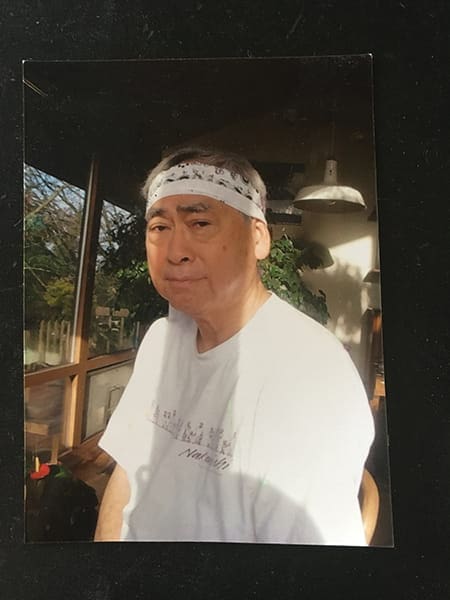
Sam Goto
Photo courtesy of Brad Holden
Seattle Tomodachi quickly became a hit. Sam worked tirelessly on the series for several years, even after his health began to decline. Finally, in late 2017, Sam drew what would be his last strip and checked into a hospital. He would later be released to hospice, and, adhering to the number three, died three weeks later on December 31st.
Following his death, Kelly moved back into the family home to help care for her widowed mother. Traces of Sam were everywhere: journals, drawings, scraps of paper with ideas scribbled on them, as well as his original sketches for his comic series. Wanting to honor her late father and being creative herself, Kelly decided to publish his entire body of work. And thus began the journey that resulted in Seattle Samurai. As Kelly explains, it was an important part of her mourning process that helped her connect to her dad’s life philosophy, while also telling the very American story of immigration, with all its hardships and successes.
The book is a rewarding work of art that weaves family photos, illustrations, and assorted historical ephemera throughout its pages, as well as the complete collection of Sam’s comic series. And because Bushidō was such an important life philosophy for her father, each of the book’s eight chapters is based on the eight Bushidō virtues.
According to a popular Japanese proverb, “When three people meet, wisdom is exchanged.” We see this in the legacy of Seattle Samurai, beginning with Shigeru Osawa, followed by Sam Goto and his comic series, and concluded by Kelly Goto in this book. Three different voices from three different generations, all converging into one remarkable story that covers topics from family love to cultural assimilation, while also documenting some of the key historical events that have shaped our region.