



How did you hear about Full Pull?
That was the first question I asked every customer who walked through our door back in the early years (I founded Full Pull Wines in 2009, and for the first few years, I was the sole employee).
The most common response? “I can’t remember.”
They didn’t know, but I knew. They had heard about Full Pull from a friend or a colleague, a family member, or an acquaintance. Someone had opened a great bottle of wine for them and proceeded to evangelize the place where they found it. While few could pinpoint the origin, most guests had heard about Full Pull the same way: through word of mouth.
In those early days, and all the way through today, word of mouth is our No. 1 marketing tool, and I’m convinced it’s the stickiest tool there is for customer retention. Advertising allows a business to find new customers; word-of-mouth helps a business find the right customers.
There are many models for growing a small business. For my particular venture, slow and steady was the right approach, and I had settled on it during one of the most thrilling periods of my life: my second year of business school.
I know, “thrilling” and “business school” do not typically appear in the same sentence, but most people don’t go to the University of Washington’s Foster School of Business, a small, nurturing program. Most people don’t have an associate dean who will allow a second-year student to earn independent study credit for fleshing out a business plan. And most people won’t have encountered an entrepreneurship class taught by Emer Dooley.
“I liked slow meals and slow hikes; long documentaries and long trips. I liked the idea of having kids someday and actually parenting them with my partner. None of that sounded possible while worshipping at the altar of the work hard/play hard mentality.”
Emer changed my life. In the lead-up to the point at which I encountered her class, I had one model for entrepreneurship and business growth: the “hockey-stick curve.” Pitch your idea to venture capital or private equity firms; work 80 hours a week; grow exponentially; cash in your shares and become generationally wealthy. If you’re lucky, maybe you retire at 40 or repeat the process with your next scalable idea.
That always sounded … terrible to me. I liked slow meals and slow hikes; long documentaries and long trips. I liked the idea of having kids someday and actually parenting them with my partner. None of that sounded possible while worshipping at the altar of the work hard/play hard mentality.
Then Emer’s class came along, and she introduced me to the notion of “lifestyle entrepreneurship.” A lifestyle entrepreneur is someone who designs a business to prioritize work-life balance rather than rapid growth or maximizing profit.
Something clicked for me. That was what I wanted. I had been writing a wine-focused blog (remember, this was the early 2000s; blogs were cool) and people were leaving comments all the time in the vein of “this wine sounds great; where can I get it?” I knew there was the kernel of a business there; a career doing what I loved, which was writing about wine, and then finding a way to sell those wines and make a modest living doing it. It was never going to be a scalable multi-billion-dollar business, and once I understood and accepted that, it was time to craft a proper business plan.
Full Pull was completely bootstrapped—we had zero outside investment. That, of course, put serious constraints on the business. In the early years, we had to choose between prioritizing growth (via actively budgeting for marketing and advertising) or customer experience. Having settled on the path of the lifestyle entrepreneur, that choice was easy. We focused all our resources on customer experience, and slow-and-steady growth was a natural result thanks to word of mouth. The customer experience was so relentlessly positive that we ended up with evangelist patrons who became our de facto marketing team.
For the first decade of Full Pull’s existence, we were a paragon of slow-and-steady growth. Some years we were up 2 percent; some years we were up 10 percent. We could accurately forecast when we would need new hires and when we would need larger parcels of wine. It was manageable, and it was fun.
Then COVID-19 hit, and I experienced two years of the hockey-stick growth we never intended. Restaurants closed, stress-drinking soared, and we were perfectly positioned to sell piles of wine. During the two COVID years of 2020 and 2021, our revenue jumped by more than 60 percent, and our profitability soared.
And I was miserable.
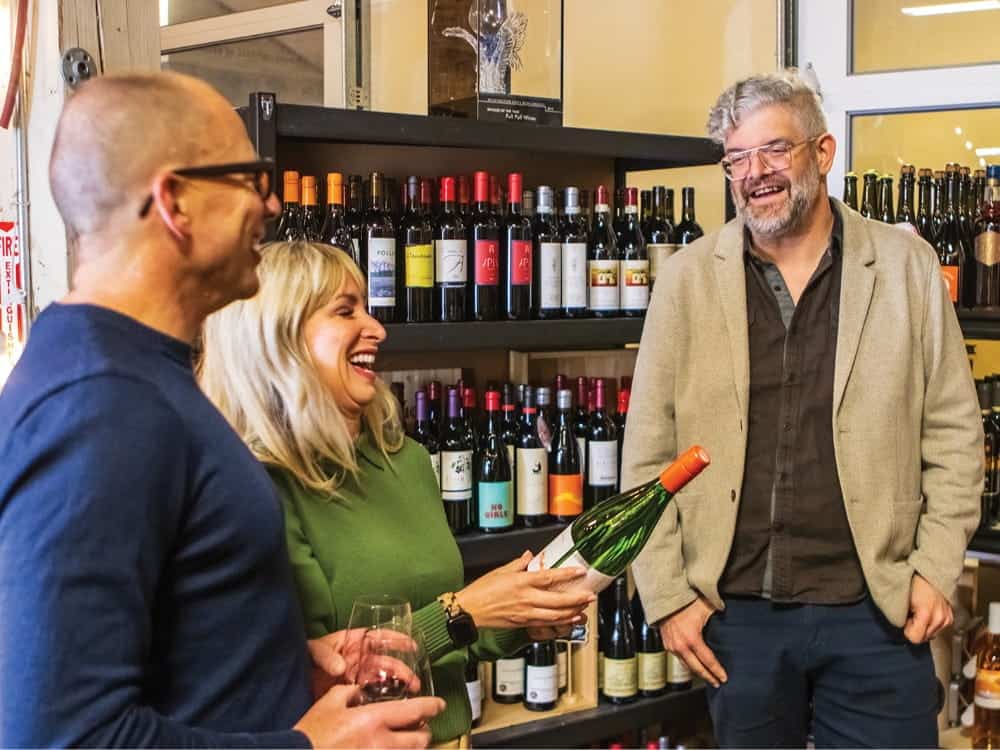
Owner Paul Zitarelli chatting with customers.
Photo by ROSE & SALT SOCIAL
It was the most stressful time in my professional life. Our team members burned out, our forecasting models were all wrong, and I could barely sleep. It was both lucrative and, for me, completely unmanageable.
During the past five years, it has been somewhat of a relief to return to the slow-and-steady curve that I like. Our team is happy; our customers are happy. Most of all, I look forward to going to work and coming home to all the other interests and responsibilities that define a rich life.
Paul Zitarelli is the founder of story-driven retailer Full Pull Wines. In addition to curating the stories that shape Full Pull’s wine program, Zitarelli is also the author of “36 Bottles of Wine” and was the longtime wine writer for Seattle magazine. He lives on Bainbridge Island with his wife, two children, and one skittish cat.