



Hiking is an extremely popular hobby in Washington, especially in the summer, with hundreds of trails to choose from across numerous national parks and forests. In my case, I’ve spent more than half of my summers hiking in Mount Rainier National Park and Mount Baker-Snoqualmie National Forest, and I love seeing wildflowers in bloom, catching sight of deer and marmots, and enjoying a well-earned meal afterward.
Oftentimes, hikes are listed as easy, moderate, or hard, but that’s only one piece of the puzzle when it comes to finding a hike that’s right for you. There are a few factors to consider when choosing a trail, finding the right gear, and ensuring that you leave no trace.
Choosing a trail that’s right for you
When Sydni Mullen, a content creator known as @earth2sydni online, moved to Seattle in 2023, she loved the proximity to nature. “There’s a lot of scenery, but it’s not overwhelming in the way a city is,” Mullen says. “It gives me space to breathe and clear my mind.”
After moving to Seattle, Mullen started Hike+Yap, which hosts community hikes to help people gather and connect outdoors. When it comes to choosing a hike for her own adventures or for Hike+Yap, Mullen starts by looking at distance and elevation gain. Hikes with a high elevation gain over a shorter distance are more likely to be labeled as moderate or challenging. Take Mailbox Peak: The newer trail is 9.4 miles round-trip with a 4,000-foot elevation gain, while the original, much steeper 5.4-mile trail covers the same elevation gain.

Mullen on Dirty Harry’s Balcony trail.
Courtesy of Sydni Mullen
You can also consider how long you want to spend on your hiking adventure. A trail that’s 30 to 45 minutes away may be well suited for a half-day hike, but a trail that’s 1.5 hours away may require a full-day trip since you’ll spend three hours driving. There are also several hikes, walking trails, and parks close to Seattle. North Bend, for example, is home to trails such as Dirty Harry’s Balcony, Mount Si, and Rattlesnake Ledge, some of which Hike+Yap has featured as events. “I try to showcase smaller trails or places that are closer, and invite people to be more curious about the outdoors and what it provides,” Mullen says.
You can also find, save, and read comments about hikes on AllTrails and the Washington Trails Association website, both of which provide more context about popularity, shadedness, terrain, parking, and road conditions. If a trail seems particularly popular, consider saving it for a weekday hike to avoid weekend crowds.
Once you’ve chosen your hike, check whether you need a hiking pass. A few common options are the Northwest Forest Pass for Forest Service-operated recreation sites in Washington and Oregon, the Discover Pass for Washington State Parks and recreation lands managed by the Department of Fish and Wildlife and the Department of Natural Resources, and an Interagency Passes. For the Discover Pass and Northwest Forest Pass, you can purchase a one-day pass or an annual pass depending on how often you plan to use it. You can also plan your visit around a pass-free day, which coincides with specific national holidays and other occasions. And if you don’t have a car or want to hike without needing a pass for your vehicle, you can use Trailhead Direct through August 30, which runs from Seattle to Mount Si, Little Si, and Mount Teneriffe.
Packing your hiking essentials
It’s helpful to look up trail details in advance—including the terrain, elevation gain, and weather—so you can pack accordingly. Many essentials are meant to cover your bases and protect you in an emergency, starting with the 10 essentials, organized into key categories:
1. Navigation: Map, compass, and GPS device
2. Sun protection: Sunscreen, a wide-brimmed hat, sunglasses, and sun-protective layers
3. Clothing: Jacket, hat, and gloves
4. First aid kit: Bandages, gauze, disinfecting ointment, and medication
5. Light source: Flashlight or headlamp and extra batteries
6. Fire: Lighter, fire starter, or matches
7. Repair tools: Multi-tool and duct tape
8. Food: Snacks, which may include fruit, nuts, bars, etc.
9. Water: Drinking water and water treatment supplies
10. Shelter: Tent, tarp, bivy sack, or emergency blanket
In addition to packing your bag, let someone know where you’re going and how long you plan to hike. “This is especially important if you might be in an area without cell service,” Mullen says. “If anything happens, there’s someone who will know where you are.”
Finding gear
When it comes to finding gear to wear and use while hiking, you’ll likely need good hiking shoes and, ideally, some moisture-wicking socks. Typically, hiking footwear falls into two categories: hiking boots, which offer more ankle support and are more waterproof, and hiking sneakers, which sit below the ankle and are generally lighter and breathable. To find what style you prefer, try on both options and walk around to get a sense of what’s comfortable for you. Your feet will swell from walking and hiking, so it may be helpful to try them on toward the end of the day. And once you choose your hiking boots, break them in by wearing them on shorter walks before hitting the trails.
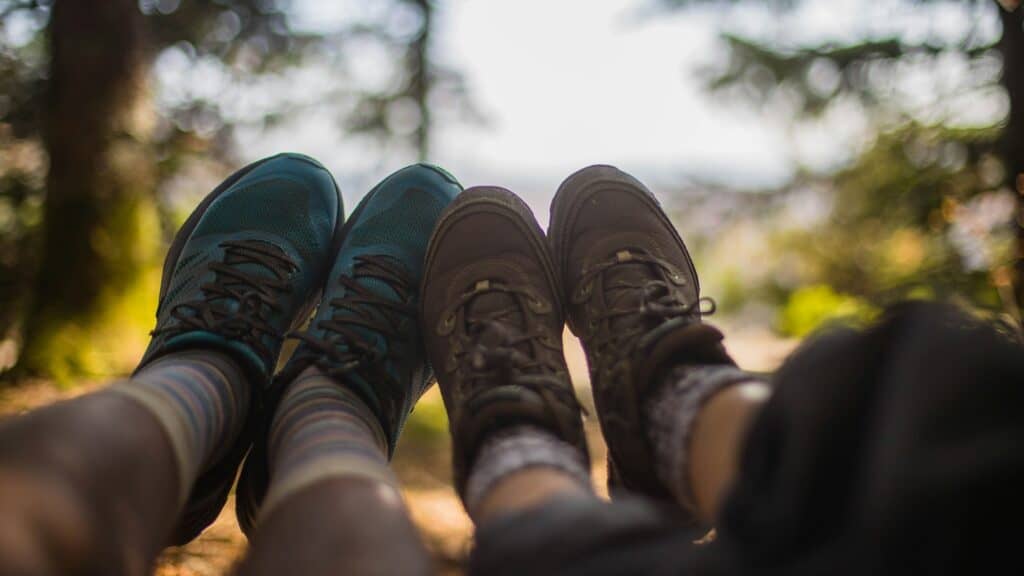
Boots on the ground. Try on a few pairs to find hiking shoes that feel comfortable before hitting the trail.
Photo by Dayne Topkin / Unsplash
When it comes to getting the gear you need, Mullen suggests building your collection of gear over time based on what you really need or use. “Investing in hiking gear can get expensive quickly, so I recommend checking out a thrift store or a place that resells gear like REI Re/Supply, Wonderland Gear Exchange, or Ascent Outdoors,” Mullen says. “You’re going to get everything dirty anyway, so you don’t have to break the bank.”
Leave no trace and hike responsibly
No matter where you’re hiking, you can practice responsible recreation by following Leave No Trace principles. In other words, plan ahead, travel on durable surfaces, properly dispose of waste, respect wildlife, leave what you find, minimize campfire impacts, and be considerate of others. The first step is to familiarize yourself with local regulations and ensure that you’re being a steward of the land by not leaving anything behind. Mullen tries to leave each space better than she found it, and she carries a trash bag to ensure that all waste from Hike+Yap events is consolidated.
“Be respectful of these spaces and remember how delicate the environments are,” Mullen says. “You can’t feed the animals and go off the path without it having an impact.”
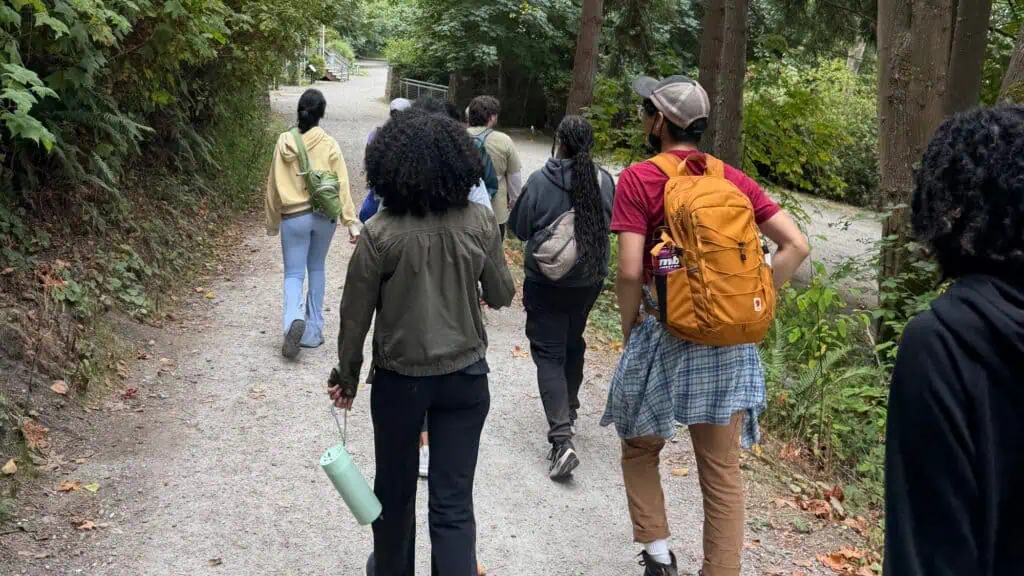
Hike+Yap at Seahurst Park.
Courtesy of Sydni Mullen
Mullen also invites people to give back to nature with their time and energy, whether on the hiking trail or elsewhere. “If you enjoy nature, consider giving back in meaningful ways like habitat restoration work or participating in a beach cleanup,” Mullen says. “There are ways we can have a more conscious lifestyle while still being connected to the environment.”
No matter how you spend time in nature, it helps to do your research, respect the ecosystem you’re visiting, and bring supplies that help you feel prepared. “I try to balance sharing the beauty of nature and educating people on what it takes to keep these spaces healthy and protected through stewardship and reciprocity with the land,” Mullen says.
Follow @Hike+Yap to stay up to date on future events.