



Ideas are everywhere. Sustainable businesses are much harder to build.
Between finding product-market fit, hiring the right people, raising capital and simply working out what to do next, the distance between an idea and a viable company can be enormous.
For more than a decade, iAccelerate has been helping thousands of founders close that gap.
The UOW-backed incubator and accelerator has supported more than 600 startups across clean energy, AI, fintech, healthcare and social enterprise, from early-stage ventures to global companies employing hundreds of people.
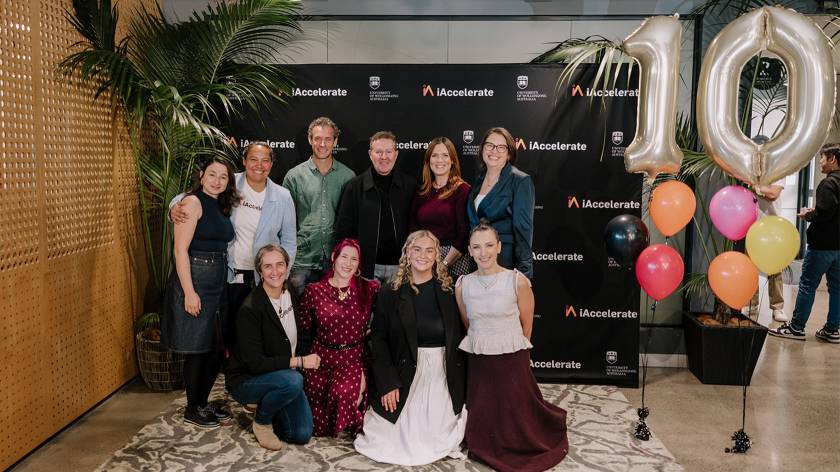
As it marks 10 years in its current home at the iAccelerate centre, Australia’s largest purpose built facility, offers a revealing look at what founders really need to turn an idea into something that lasts.
Inside iAccelerate, there’s an immediate hum of activity.
Across three storeys, founders at various stages work side by side. Its three core programs reflect that progression: Activate helps entrepreneurs test and validate an idea, Accelerate supports startups preparing for market and Advance is designed for businesses as they scale.
But iAccelerate’s purpose extends well beyond the building itself, creating a hub where founders can leverage the region’s existing assets.
“We’ve got a deepsea port, we’re close to the city, we’ve got light and heavy industrial land,” iAccelerate director Dr Tamantha Stutchbury tells Startup Daily. “We’re actually so well connected and, in many ways, easier to grow a company than in a big, high-density city.”
When iAccelerate was established, Wollongong had no shortage of talent. Throughout the late 2000s and early 2010s, the UOW was producing some of the largest cohorts of ICT graduates in NSW, yet many were leaving the region for work or commuting to Sydney each day.
“There was a real long-standing set of companies, but growing the next [generation of] innovative companies just was not happening,” says Sutchbury. “Graduates would leave if they wanted to create an innovative company.”
From the outset, the aim was to create a place where founders could build global business locally from Wollongong.
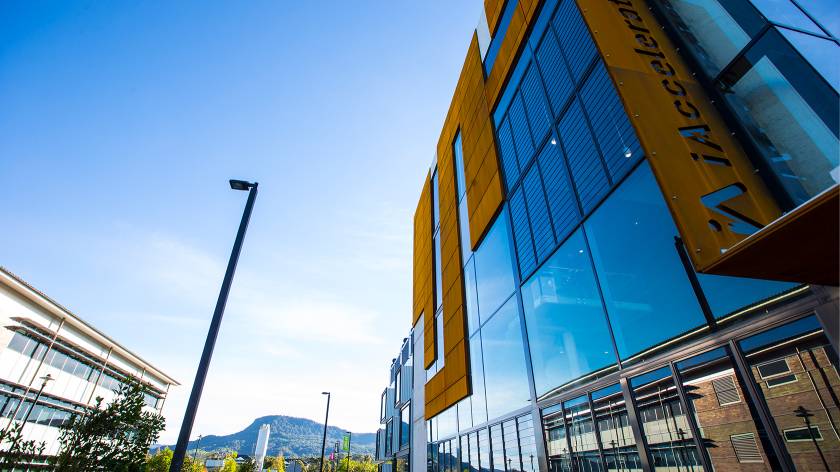
The building itself reflects that ambition. Flexible workspaces can adapt as companies grow in size, with meeting rooms, event spaces and specialist facilities including maker and recording studios also available. Even the exposed steel details are intentional, a nod to Wollongong’s industrial history.
“The building is a visual representation of the fact that the region is startup-focused. It has a home for startups,” Stutchbury says. “We’re like a lightning rod that says innovation is important to this region.”
While the types of startups coming through iAccelerate have evolved, program and community manager John Kerr says the support founders need is often much the same.
“They want community, they want support, they want mentorship, and they want investment,” he says.
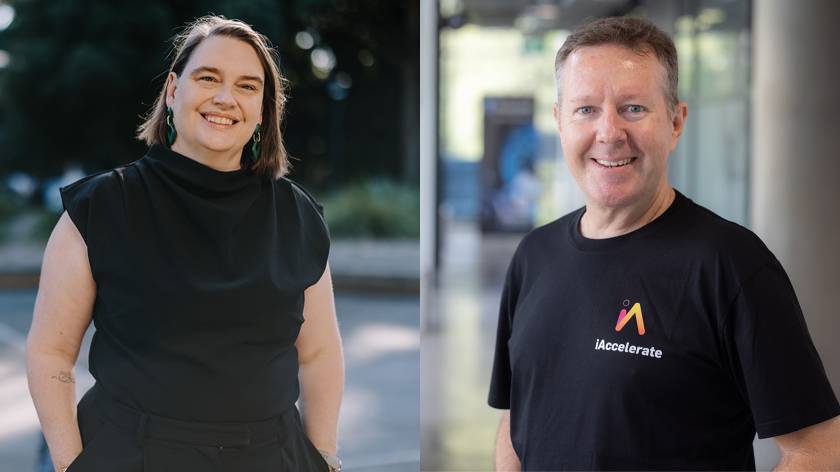
According to Mark Swinnerton, founder and CEO of Green Gravity, this access to community has been one of iAccelerate’s key advantages.
“One advantage of iAccelerate and the broader Innovation Campus is the connectivity to other businesses, both startups but also operating businesses. We have access to accountants, HR consultants, insurers and project managers all located here,” he says. “It has made it easy to get things done. It’s a really important collaborative environment.”
At iAccelerate, the support given to entrepreneurs spans education programs, expert mentoring, physical workspace, access to university’s expertise and talent, investment networks and a wider community of founders and alumni.
That support has also included access to capital. The UOW established a sector-leading $10 million iAccelerate seed fund in 2014 to invest in emerging businesses, alongside broader investor networks and funding connections.
As part of UOW’s Innovation Catalyst, a new $10M fund will be launched later this year, showing a continued commitment to investing in innovation.
The iAccelerate model is deliberately flexible. Companies can stay while they are still growing, whether that means spending six months in the program or expanding across almost an entire floor before moving on.
For Sample Assist CEO Heath Cooper, that flexibility has provided the breathing room to turn an idea into a business ready to scale.
The company has spent the past three years developing an end-to-end platform for workplace drug testing, while Cooper has also been completing an Industry PhD at the UOW.
“We know that the platform works, we know the market wants the product, we’ve priced the product, and so now it’s a growth stage for us,” Cooper says.
Having considered incubators in Sydney, Newcastle and Canberra, Cooper says iAccelerate’s focus on flexibility and education stood out.
For growing startups it means that they can focus 100% on their startup and adding space, people and support as needed, rather than committing too early to costly overheads.
“The most precious item in a startup is the availability of cash,” explains Cooper. “The greatest advantage an incubator can give a startup is being able to really reduce the cost impact on that startup so that the money can go directly to the engineer to make the product.”
Sample Assist has also tapped into the university’s talent pipeline, with 207 interns working with the company over the past three years.
Over time, iAccelerate has supported a broad mix of founders and businesses, reflecting both changing startup trends and the strengths of the region around it.
Recent cohorts have included strong representation in areas such as AI and energy transformation.
“Wollongong is really at the forefront of that energy transition,” says Stutchbury, pointing to companies such as Green Gravity, Ingeteam and Gridsight.
That strength is partly driven by the region itself, with expertise, investment and industry demand creating fertile ground for new energy businesses.
But Stutchbury says iAccelerate’s appeal is also its breadth.
“We are cross-sector,” she says. “We’ll have social enterprises, deep tech, PhD students, serial founders and professors all in the same cohort.”
Some of the businesses to come through iAccelerate have gone on to achieve significant scale.
Green Gravity is putting Wollongong at the global forefront of gravitational energy storage technology, while Gridsight has raised US$26 million in a Series B, while BinaryTech has built an international footprint through its IoT technology.
For Kerr, those outcomes are a reminder that startup success can take many forms.
“Success isn’t just a billion-dollar company,” he says. “It’s also a company with four or five staff that’s continuing on, that’s going to continue on for the next 10 or 20 years.”
Thinking about building or growing your business in Wollongong? Explore iAccelerate’s programs and discover the wider opportunities, support and connections available through Invest Wollongong.