



Art by Northwest
Current shows offer glimpses of our complicated nation, through paintings, light sculpture, folk-art quilts and music.

It’s July 4th weekend and this is a big birthday for the U.S.A. — marking 250 years of independence.
I’m old enough to remember the Bicentennial, in 1976, when my second-grade classroom spent a lot of time learning to sew bonnets and tri-cornered hats. We were also taught several square dances, which we performed with varied success in our small town’s parade (one of my earliest immersive dance experiences). At that time I didn’t likely have much of an understanding of America, but I did enjoy the allemande left and the do-si-do.
You’re reading Art x NW, a weekly arts and culture newsletter from Cascade PBS. Read past issues and subscribe for more.
This national birthday is complicated at best, but the holiday’s co-incidence with the World Cup brings a glint of optimism. One of the countless commentaries I’ve read noted that this international sporting event has turned out to be the best way to celebrate America’s 250th — reminding us of the U.S. as seen through the eyes of global tourists enchanted by our enthusiasm and high-calorie foods. It’s a reminder that we can root for the home team even when we don’t much care for the landlord.
Artists have always provided us with new ways of seeing our country, of course. Several shows currently on view speak to the impact of such fresh perspectives — whether optimistic, critical or simply insightful.
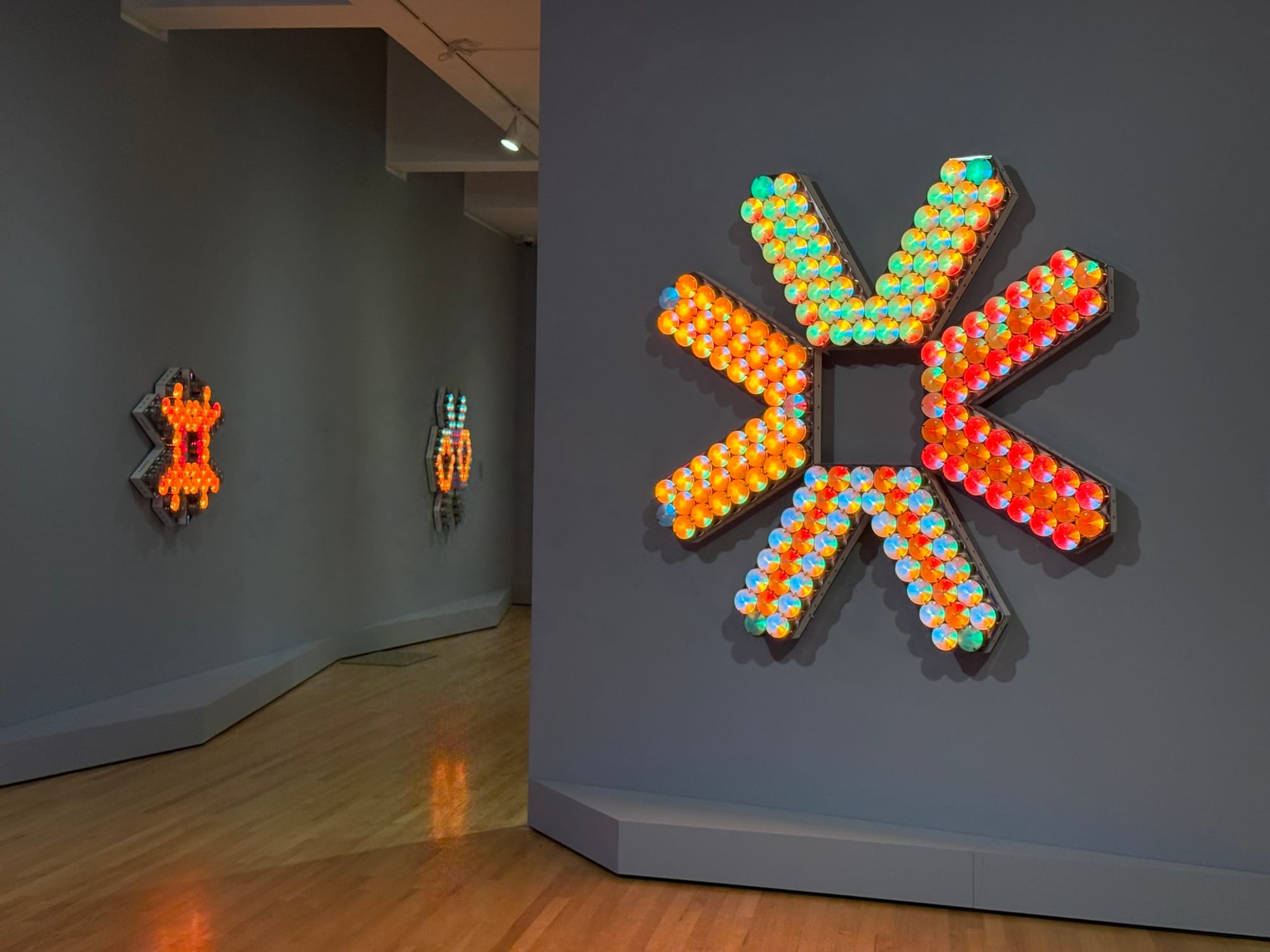
Consider the Frye Art Museum’s retrospective of American artist Tom Lloyd (through Sept. 20). In the 1960s, the trailblazing sculptor created abstract assemblages of colorful, blinking lights. In doing so, he illuminated a pathway for light-as-art, as well as for Black American artists.
Lloyd’s minimalist, geometric works flash through electronically programmed light patterns in amber, blue, green and red, suggesting a big city at night (namely New York, where he lived and worked). His clever repurposing of Christmas lights and Buick tail lights suggest the archetypal American image of a guy tinkering in his garage — albeit one with tremendous creative vision. Walk into the show and you’re hit with not only the pleasing light show, but the soft mechanical clicking as each pattern makes its rhythmic rounds. It feels like a quieter but no less sparkly fireworks show.
The artworks stood out at a turbulent time in U.S. history, when most prominent Black artists were making work that reflected the Civil Rights Era and the importance of identity, history and struggle. Lloyd’s sculptures — which served as the inaugural show at The Studio Museum in Harlem in 1968 — were deemed by some contemporaries as “not Black enough.” But Lloyd remained steadfast in his belief that Black artists could work in any style. “We’re Black,” he told the Museum of Modern Art. “No matter what kind of work you do, you’re influenced by all these things.”
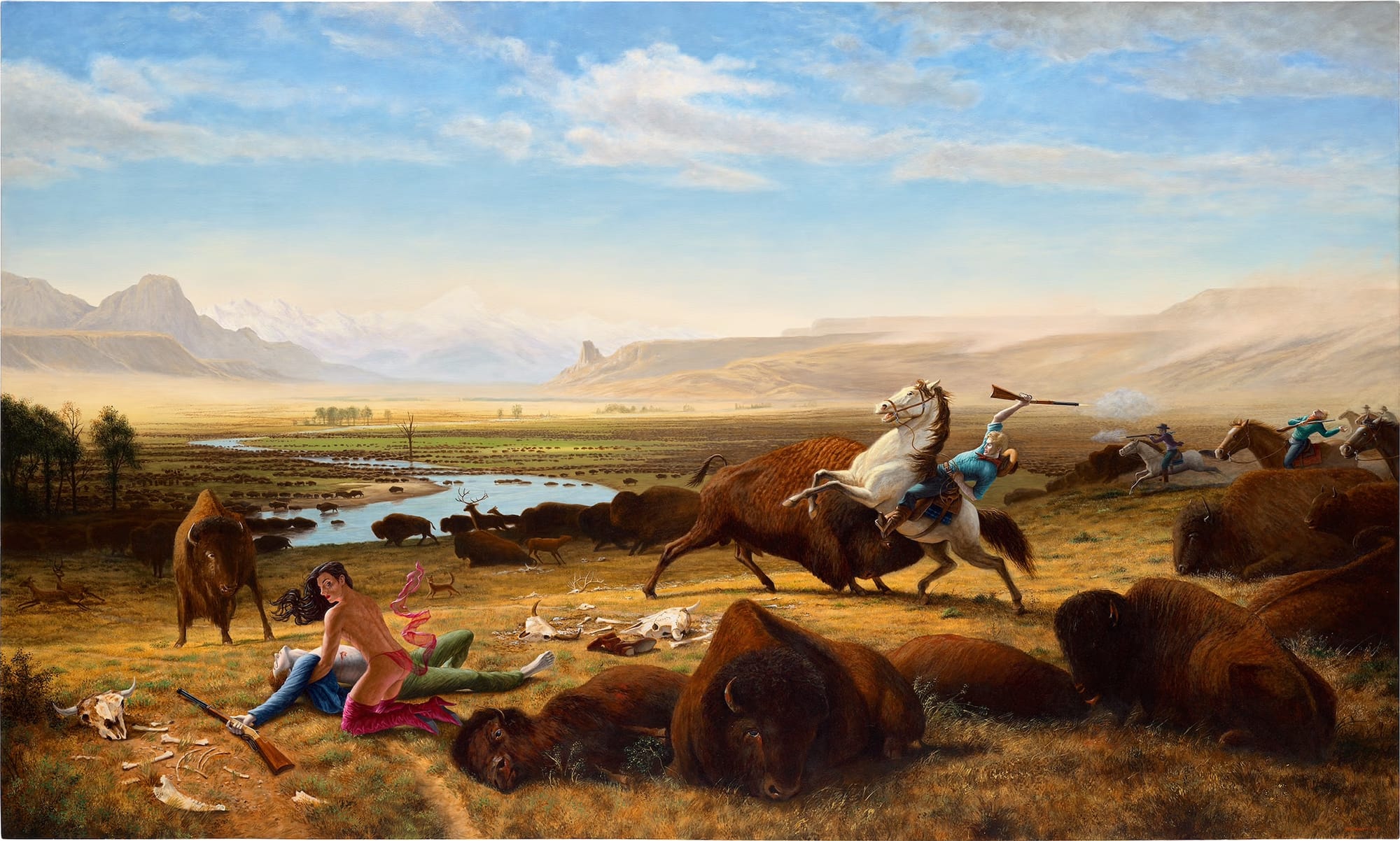
At Tacoma Art Museum, a new gathering of paintings offers another look at America through an artist’s keen lens. Death of Adonis(through Jan. 3, 2027) is a landscape painting by contemporary Cree artist Kent Monkman. He created the work as a direct response to Albert Bierstadt’s iconic (and controversial) painting “The Last of the Buffalo” (1888).
The earlier work depicts a vast American West, at the foreground of which is a herd of wild buffalo in various states of life and death. One is about to be killed, it appears, by a scantily clad Native American on a rearing horse. Bierstadt intended the large-scale work as a mournful commentary on the simultaneous disappearance of the buffalo population and Indigenous culture.
In reality, the buffalo were already nearly gone when he painted the piece, due to the American military’s slaughter of the animals in a calculated effort to starve Native communities and move them onto reservations.
Monkman’s 2009 painting recreates the monumental Western scene, but in his work, a cowboy rides the rearing horse — and he’s about to get knocked off by the buffalo. Another notable difference: Monkman has added the figure of his gender-fluid alter ego, Miss Chief Eagle Testickle, wearing pink panties and kinky boots. Kneeling over a dead cowboy and facing the viewer, the character reveals that in fact, Native culture persists and is ever evolving.
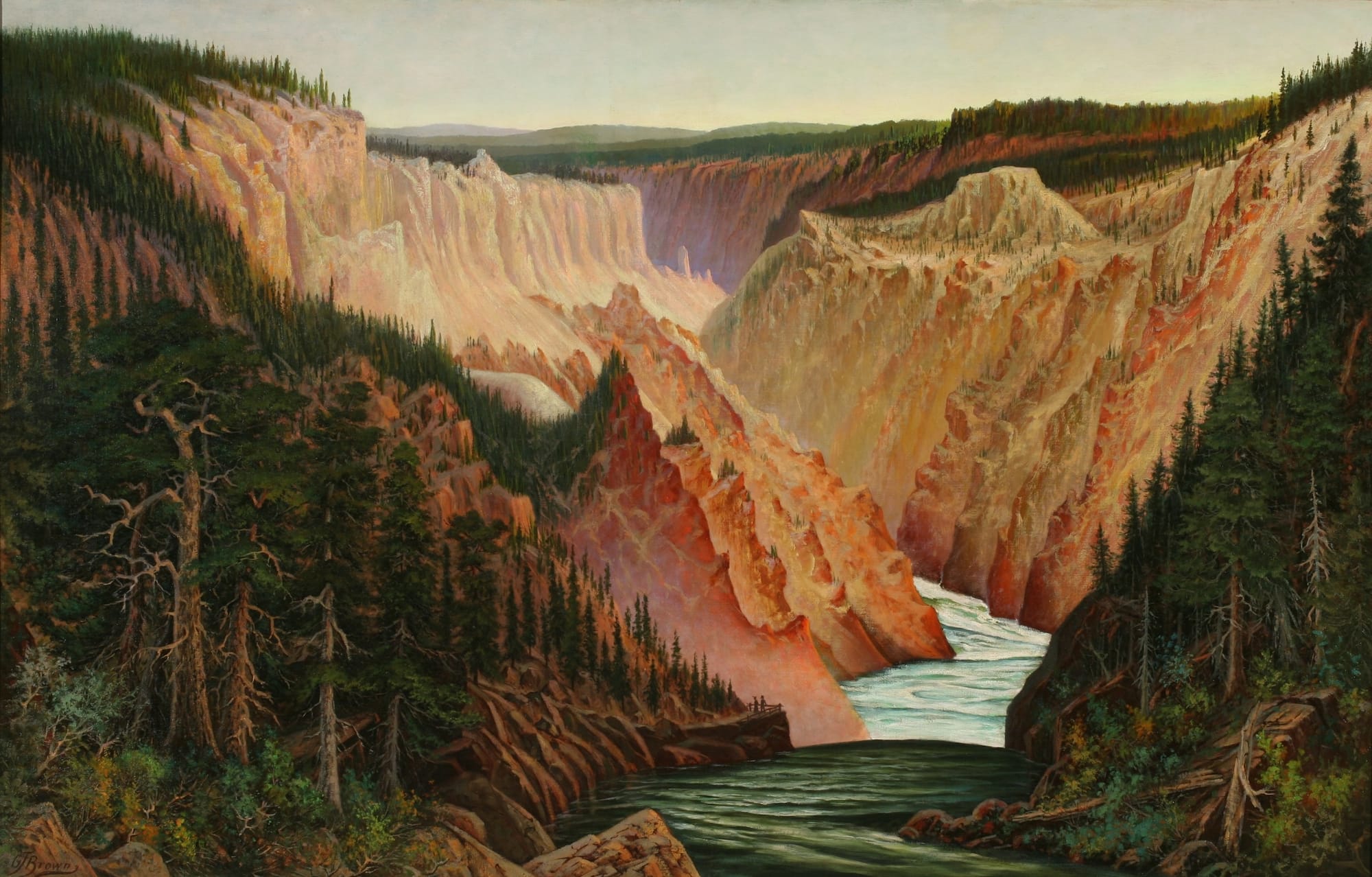
The companion installation Visions of the West: Grafton Tyler Brown (through Jan. 3, 2027), features two major works by a respected American landscape artist of the late 19th century. Tyler Brown was recognized for his large-scale oil paintings of natural vistas in California and the Pacific Northwest. His expansive scenes pair deep greens with pastel pinks — beautiful places frozen forever at the golden hour.
What’s unseen in these works is what must have been a life-changing decision for the person who painted them: Around 1880, the Black artist Tyler Brown began passing as white. Very little is known about his biography, which was perhaps his choice. But knowledge of this detail adds nuance to the viewing of his work, his portraits of an idealized America.
Meanwhile up north, the Museum of Northwest Art in La Conner has mounted a new exhibit of work by longtime Seattle artist Ross Palmer Beecher. Speaking in the Vernacular (through Sept. 20) features the artist’s take on Americana and folk art, specifically her signature “quilts” made from household detritus, stapled tin and copper wire. Sometimes funny, always cheeky, her works beckon the viewer closer in wonderment at her curious use of materials.
What might look like a traditional fabric quilt pattern from afar quickly comes into focus as painstakingly assembled items including aluminum, plastic bottles, industrial signage, maps, tea pot spouts, denim, keys, watch faces, and in her portrait of F.D.R., welded dimes and pennies. In other words, Palmer Beecher uses the flotsam and jetsam of American life to weave tapestries that reflect us back to ourselves.
We’ll end with a few more ways to experience America during its birthday month.
< The new, daylong music festival Seattle Center Classical features an impressive line-up of orchestral, chamber, opera and choral performances by local organizations. Included in the mix is Seattle Chamber Music Society’s presentation of “American Favorites,” as in George Gershwin, Samuel Barber and John Philip Sousa. July 5, noon-6 p.m. “American Favorites” at 1 p.m. and 3 p.m.
< Grammy-nominated and New Orleans-based, the Rebirth Brass Band plays more forms of signature American music — including jazz, funk and soul — at Jazz Alley. July 7-8
< Coming up at MOHAI, the Freedom Plane National Tour: Documents that Forged a Nation showcases the essential paperwork that built the U.S.A., including an original engraving of the Declaration of Independence, a secret printing of the Constitution in draft form (from 1787), the Treaty of Paris and the Bill of Rights. July 30 – Aug. 15
< And finally, perhaps the best way to celebrate the 250th: The public Naturalization Ceremony at Seattle Center. This annual event is incredibly moving, a civic tradition that reminds us — and rejoices in the fact — that we are a nation of immigrants. July 4, 12-1 p.m.
Check out Season 2 of our television show Art by Northwest, featuring in-depth interviews with the printmakers, painters, sculptors, wood carvers and photographers who are creating captivating work across Washington state. Nominated for two Northwest Regional Emmy Awards.