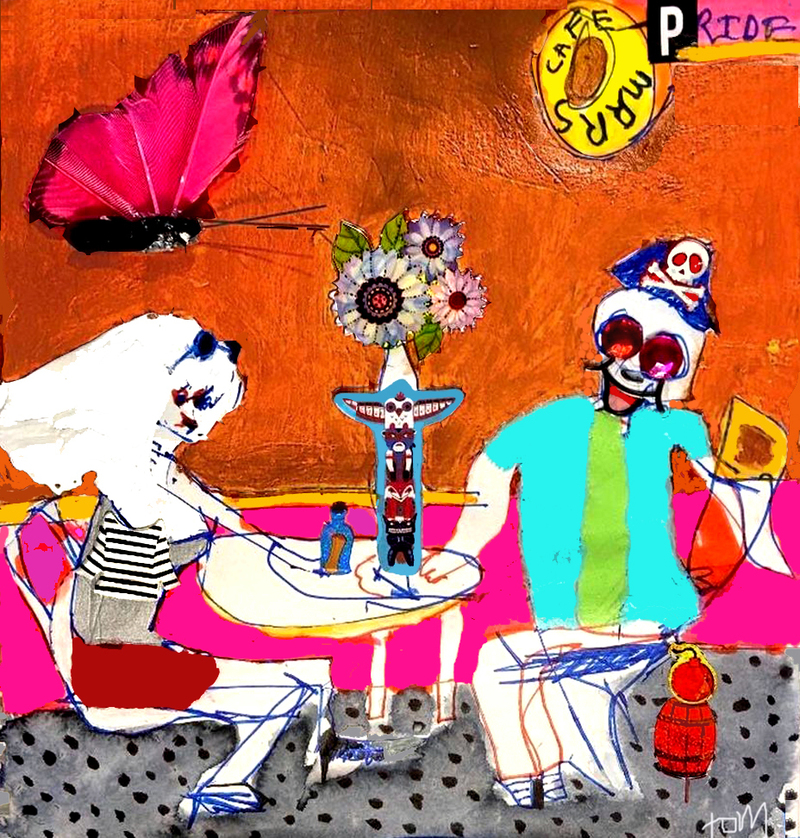



The most 86ed man in Seattle. The friends of Tom Barnes agree about that. They rattle off an incomplete list: He was definitely banned from Big Mario’s once, as well as the old Comet, where he tumbled off the bar and broke a leg. He was barred from Saint John’s for years at a time, once because he’d crashed through the glass in the front door, the other times because he’d left the water running in his apartment upstairs, causing the establishment to flood—on three separate occasions. At some point, he realized the entire Saint John’s staff had turned over; with no one left to remember the debacle, he was free to patronize the joint again.
A few weeks ago, a small group of friends gathered on the back patio of Saint John’s Bar and Eatery. Surrounded by an army of plastic dinosaurs crouched in the grass, they discussed plans for his memorial, and to reminisce. The 74-year-old artist had passed away, unexpectedly, in early July.
Seated to my right was his neighbor and fellow artist who lived across the hall, Katlyn Hubner; Diana Adams, owner of Vermillion Art Gallery and Bar; Rob Joynes, a poet, musician, bartender, and Barnes’ accidental best friend (and the recipient of bottomless late-night texts); and Steve Gilbert, who met Barnes in the ’90s and exhibited his work multiple times at his eponymous gallery. Later came two who knew Barnes in the ’70s, when he first arrived to the Pacific Northwest from Toledo, Ohio and became enmeshed in the local theater scene. Even his landlord came to pay his respects.
I knew Barnes, but not like they did. Memories spilled out. The group blinked back tears and broke into chuckles over absurd anecdotes. There was also a profound sense of helplessness and frustration at the randomness of his death. I could sympathize: This will be the second memorial I’ve attended in two months that was the result of an accidental fentanyl overdose. Groping for a way to process grief or place blame feels impossible.
“He was loved and hated by many,” says Adams. She herself had kicked Barnes out of Vermillion more than once—a “soft 86”—when he’d gotten too rowdy.
“It took me a while to really get him,” Hubner says. “Barnes’s delivery was sarcastic, blunt. He’s a crass son of a bitch. But he took me in when I was homeless, he was always there for me. He was also my biggest cheerleader, always pushing me to hit that damn studio. He was always pumping you up, like, Keep going, kids, just stop fucking people, just keep painting!”
Barnes was an artist’s artist: a documentarian, bohemian, romantic, poet. He was estranged from his blood family; we aren’t sure why, but even his chosen family drew boundaries. One of his friends has penned an “O-Bitch-uary” to be read at the memorial. Barnes lived to party. He also lived in pain. He died from complications of both.
When Barnes was found in his apartment a few days after his death, the police locked the door and took the keys. They explained that, with no known next of kin and without a will, his possessions would pass to the state.
His friends panicked. The life’s work of a man for whom they cared deeply, despite his foibles, lay on the other side of the door. They were the only ones standing between archive and obliteration.
Joynes spent the next three days glued to his computer, scouring public records, going down social media rabbit holes, and calling every person that might provide a clue about blood relatives, dead or alive. He gradually mapped a network of friends and acquaintances that spanned decades. Someone recalled Barnes mentioning a sister at one point. But Barnes is a helluva common name. Joynes kept at it, and the sleuthing paid off: Barnes had a sister all along, estranged and living in Kirkland for the past 40 years. With her blessing, they were given keys to his apartment and possessions.

The group left Saint John’s Bar and walked around the corner to the entrance of Saint John’s Apartments. We entered and filed into a tiny studio on the ground floor. Barnes did not live here, but his work did, temporarily, with the landlord’s approval. It was overwhelming, seeing it all like that. Over 800 artworks—most on paper: drawings, paintings, and collages contained in sketchbooks and archival portfolios. It also felt strikingly small—a life compressed like this.
When describing Barnes’ work, nothing is more apropos than “fever dream.”
Characters and scenes from real life are rendered in a kind of naive, psychedelic, art-brut mannerism with the tweaky energy of a 6-year-old. But allow your eyes to adjust, and the impeccability of the composition becomes evident; there’s not a blobby figure, rogue blot, or dot without purpose. Scratchy outlines made with a Uniball pen are the scaffolding of each image, which is fleshed out in obscenely bright colors—acrid yellows, blood-letting scarlet, and neon green—with a childlike flatness. Other times, a murky haze of chalk-white overpaint lends an atmospheric depth. Amid the wet-on-wet chaos of colors, the image is abruptly punctuated by the most intricate details of bottles lined up in a fridge beyond the bar or the pattern on a frock. Occasionally, stickers and other sparkly things find their way into the picture frame. Barnes’s style is the definition of febrile. If once there was a hinge, it had come off, or was hanging by a thread.
You can tell he channeled the ghost of Ralph Steadman at some point, but had passed through and arrived on the other side, into uncharted territory and a cosmology populated by artists, dancers, friends, tavern regulars, and hot girls. He loved women, a passion as complex as everything else about him.
“One thing I think is misunderstood about his aesthetic and his artistic vision is that he was obsessed with muses and the scandalousness of youth,” says Joynes. “But I don’t think it was as perverse as people might think. I think he was always trying to capture the human experience, and human experience can be ugly, it can be bad. I think he loved the grotesque.”

Barnes only drew from human experience, never from photos. He called his documentary body of work Drawing on the Run. Some series chronicled his travels across Mexico, Cambodia, and New Orleans, but many are scenes from Capitol Hill. Series like Seattle Celebrities, Vermillion, and Pike and Nowhere are full of familiar faces: Lelah Maupin, Bethany Jean Clement, Timothy Rysdyke, Mimi Allen, Siolo Thompson, Kelly O, Casey Weldon, Ezra Dickinson. Liz Orth, Lisa Prank, and Zoe Scofield. And places: Chop Suey, the Royal Room, Vito’s, Bait Shop, Bimbo’s, Cha Cha, Cafe Racer, Vermillion, The Annex Theatre, Noc Noc, Comet Tavern, Pony, the Frye Art Museum.
Older work veered into collage. Entire volumes were dedicated to antifascist meditations, like his collection of anti-Iraq war collages, WATCHING THE WAR DRUNK. I was shocked to come across drawings rendered in an academic style; not only could he do the unhinged stuff, he could properly chiaroscuro the hell out of a figure. Barnes held a BFA in performing arts, theater, and painting from Evergreen State College. He lived and worked in New York City in the ’70s. He attended Banff Centre for Arts and Creativity on a scholarship. The naive quality of his work emerged intentionally, over time.

“What he and I had in common was that he was one of those burning people who just could not stop creating obsessively,” Joynes says. “Art was just inside of him. And when I started to put together what his influences were—he started lending me books by Frank O’Hara, Henry Miller—that’s when I realized he’s like old-school Hemingway, like a dog. He’s like an old-dog artist. They don’t make ’em like that anymore—the last of his kind.”
Of course, there’s an argument to be made that the old-school Hemingways are best left in the dustbin of the last century. Yet, there is something about Barnes’s dogged, all-consuming dedication to art that is enviable.
At one point in 2020, Barnes told me that he’d made a portrait of myself and my eventual husband. He’d caught us, 8-by-8-inch sketchbook in hand, during a drizzly Juneuary at a Pride concert on the Hill. I was dumbfounded by the result. He depicted me in a striped shirt I definitely was not wearing. Likewise, my “bestie” (as per the painting’s title) is wearing a pirate hat with skull and crossbones and a neon green shirt he was also definitely not wearing. My eye sockets are black scribbles. An impossibly giant pink butterfly (also not there) hovers over my head. According to his site, it was sold at some point, I have no idea to whom.
When I look at the image now, I can see what he perceived: two besotted bohemian pirates enjoying a rainy Seattle summer. Too much black eyeliner. It looked exactly like us.
I find myself returning to a passage from Chris Kraus’s 1999 essay “Pussy Orphanage”: “When an artist dies before his or her time, who manages the estate and how, becomes vitally important.” She continues: “Altruism aside, how is it that any artist’s work will come to survive for others in the future? Works of art, after all, are mute and can’t speak for themselves.”
Barnes’s chosen family—the poets, artists, bar owners, and hell-raisers—are speaking for the art. A retrospective of rescued work will be on view at Vermillion, a place he loved, through October 3. It is aptly titled The road goes on forever and the party never ends. The man chose his family well.
The road goes on forever and the party never ends is on view at Vermillion Art Gallery and Bar through October 3. A memorial will be held September 5.