



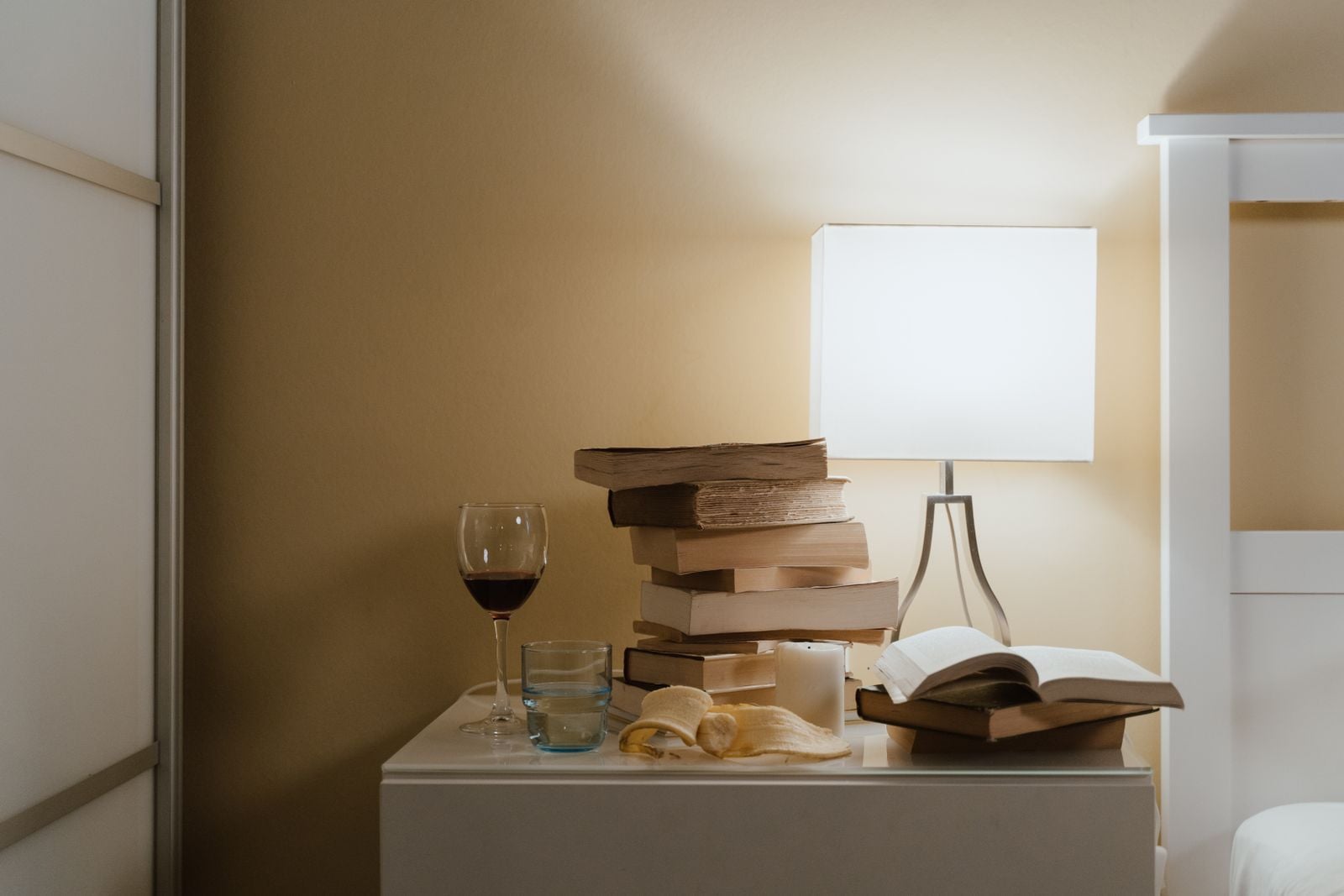
The books have been there for years. A memoir with a bookmark stalled at page 47. A novel someone gave you three birthdays ago. A collection of essays you keep meaning to finish. Something spiritual you read when you can’t sleep, and something practical you never actually open. The stack doesn’t move. It doesn’t shrink. And most nights, you don’t touch it.
Most people would call this a failure of follow-through, evidence of a scattered mind or a busy life. That reading is too simple.
What sits on the nightstand is rarely about reading. It’s about permission.
The stack as a signal, not a project
A pile of unfinished books on the nightstand looks like an intention that never came to anything. Look closer and it’s doing a different job entirely. The books are markers. They tell you the day is over, that this room is not the office, that whatever you didn’t get to today can wait until the covers of one of those books gets cracked open again, which will be some other night, possibly never.
The stack is a boundary made of paper.
Building on the concept of the transitional object — the blankets and stuffed animals children pick to soothe themselves through the small separations of early life — certain objects serve emotional functions far beyond their practical use. According to developmental psychology literature, these objects function as what researchers call transitional or ‘not-me’ possessions — self-chosen, sensorial items that help make the world feel predictable. As development specialist Colleen Goddard has written for Psychology Today, such objects remain important into adulthood, though adults disguise them as decor.
Why the books stay
If the goal were to finish a book, the stack would rotate. Finished ones would leave, new ones would arrive. That’s not what happens. The same four or five books sit there for years because their function is not to be read to completion. Their function is to be present.
Each one represents a version of the evening you meant to have. The novel is the evening where you had the attention span for fiction. The spiritual book is the evening you wanted to feel steadier. The essays are the evening where you were curious about the world. The practical one is the evening you were going to become slightly better at your life.
They are all possible endings to the day. Having them stacked within arm’s reach means the day is still open to being ended well, even if it won’t be tonight.
Research on adult attachment to keepsakes has found something similar. According to a report in The Economic Times, adults who hold on to childhood keepsakes aren’t simply nostalgic — they use those objects to regulate emotions during stress. The mechanism isn’t sentiment. It’s nervous-system calibration.
A book you’ve been meaning to read for four years is, at that point, more object than text.
Objects that end the day
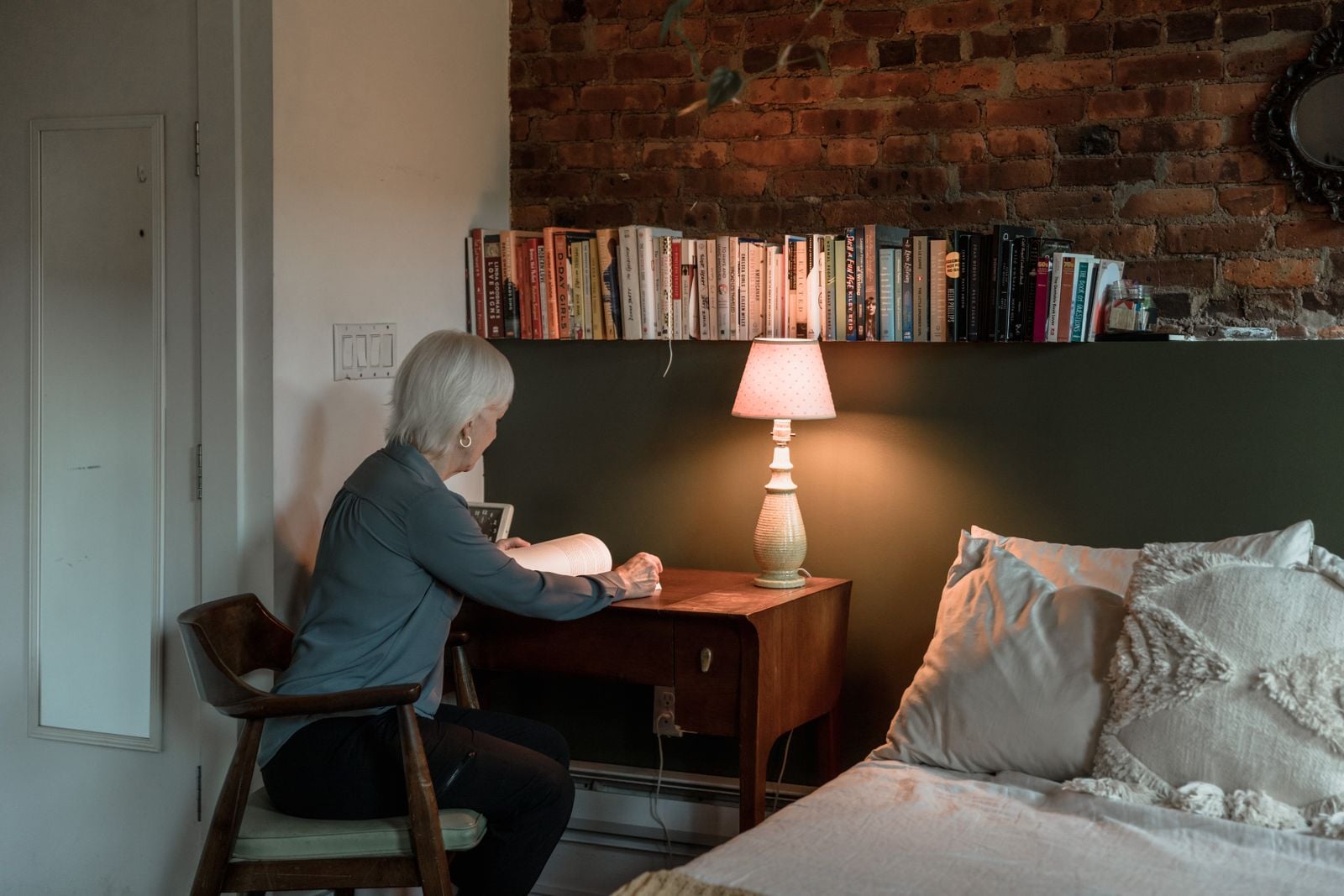
Adult life has almost no built-in stopping points. Work bleeds into evening. Evening bleeds into scrolling. Scrolling bleeds into sleep that doesn’t feel like rest. The body needs a signal that whatever mode it has been in all day is now allowed to switch off.
Consistent bedtime cues, environmental temperature, and pre-sleep rituals shape how quickly the body downshifts. A piece in Psychology Today on temperature and sleep quality points out that small, repeatable inputs matter more than most people realise for how deeply the brain rests. The bedroom, as a Los Angeles Times feature on clean sleep design put it, functions as part of a person’s health system — not just as storage for a bed.
The stack of books participates in that system. It’s a visual anchor that says: the part of the day where things get accomplished has closed.
You don’t have to actually read anything. The stack does the work by being there.
The stack as unfinished self
There’s a second layer, harder to name. The books aren’t just about ending the day. They’re about the self you would be if the day had gone differently.
The person who finishes the novel is calmer than you are. The person who reads the essays is more curious. The person who gets through the spiritual book has an interior life you keep meaning to build. The stack is a small museum of the person you keep almost becoming.
Keeping them there is not laziness. It’s insistence.
You are not willing to admit that the version of yourself who reads those books is gone. You are keeping the door open. And keeping the door open, most nights, matters more than walking through it.
Why the to-do list works differently
People sometimes ask why a stack of unread books doesn’t feel oppressive in the way an unread email inbox does. Both are unfinished. Both stare back.
The difference relates to the mind’s tendency to keep unfinished tasks active in working memory until they are either completed or externalised. A 2011 study covered by The Economic Times found that simply making a plan for an unfinished task is enough to quiet the nagging, even before the task is done.
The books on the nightstand are the plan. They are the visible commitment that this reading will happen, someday, and the mind accepts the commitment as sufficient. The inbox doesn’t work that way because the inbox is other people’s demands. The stack is yours.
That’s the whole difference. Ownership.
The ritual of not reading
Watch what actually happens at the nightstand most nights. You reach for the top book. You read half a page. You put it down. You turn off the light.
That half-page isn’t reading in any meaningful sense. It’s a handshake. It’s the way you tell your body that the day is finished and this specific object, this specific weight in the hand, this specific small typeface, means it’s time to stop.
The book that gets picked up most often is usually the one you’ve read a hundred half-pages of and will never finish. That’s not a bug. It’s the point. The familiarity is the calm.
People who arrive fifteen minutes early to appointments and pull out a book in the waiting room are doing something structurally similar — using a small ritual with a physical object to claim a piece of time that belongs to no one else. The nightstand stack is the domestic version of that same instinct.

What the stack shares with the light left on
There’s a category of adult habits that look small and look like clutter but function as environmental regulation. A light left on in one room of the house all night. A specific mug used only in the morning. A blanket kept on one particular chair.
These aren’t superstitions. They are the adult residue of what transitional objects represent in children — objects that mark the boundary between one emotional state and another, that make the transition survivable.
The observation that objects continue to function this way well into adulthood shows up even in courtrooms. A recent piece in The Legal Intelligencer discussed how a child’s attachment to a specific stuffed animal has become material evidence in custody determinations — a signal of where the child feels safe, and how each parent responds to that need. The objects are not fluff. They are data about the emotional architecture of a household.
The nightstand stack is data about yours.
Why finishing them would feel worse
There’s a curious thing that happens on the rare occasions someone actually does finish one of the long-standing nightstand books. The relief is smaller than expected. Sometimes there’s a small flatness. The book leaves the stack, and something has been lost.
The book was never really about being read. It was about being kept.
Finishing it converts it from a companion into a completed task, and completed tasks don’t offer comfort in the same way. This is why many people, unconsciously, replace a finished nightstand book almost immediately with another one they will not finish. The stack has a shape. The shape needs maintaining.
Roughly 43 percent of daily behaviour is habit, done in the same place while the mind is elsewhere. The reach for the same book, the same page, the same half-conscious skim — that’s not failed reading. That’s a habit doing exactly what habits are meant to do: automating the transition from one state of being to another.
The permission the stack gives
Modern adult life is short on permission. There are almost no external signals anymore that the day is allowed to end. The office is a laptop that follows you home. The workday finishes when you decide it does, which means it often doesn’t. Household tasks are infinite. Messages arrive at all hours.
You have to grant yourself the ending. Most people are not good at this. It feels indulgent, or premature, or like something is being neglected.
The stack of books does the granting for you. Because they are there, because they represent a version of you who is calm enough to read, because they have been sitting there for years being patient with you, they carry the authority to say: it’s fine. Stop now. Tomorrow is soon enough.
That’s what the stack is. Not a to-read list. A permission slip.
What to do about it
Probably nothing.
The impulse, when you notice a habit like this, is to fix it. Read the books. Donate the books. Rotate them. Make a system. Resist that. The stack is working. It’s doing the emotional labour of ending your days, which is not a small job, and it’s doing it for the price of a little dust.
If anything is worth noticing, it’s that the objects around you are quietly doing more than you asked them to. The mug, the lamp, the throw blanket, the four or five books you’ll never finish. They are all small stabilisers. They are all versions of the teddy bear you were once allowed to bring to school.
You didn’t outgrow the need. You just moved it to the nightstand.