



Arriving to the resort at night was briefly disappointing.
Driving north from Page, Arizona, where our short flight from Phoenix touched down along with the golden remnants of the late afternoon sun, the passing sights—much of it vast, open desert—faded into darkness by the time our group reached the Amangiri resort. I’d seen photos of the property, of course, but now I was there, and all I could make out was a vast blackness and the occasional dark form breaking up the scatter of shimmering stars overhead. As we proceeded to our accommodations to freshen up before dinner (that night’s menu was the once-weekly Utah BBQ tasting), the staff member showing me my room told me not to worry. I was staying in the Sunrise Pavilion—my morning views would be worth the wait.
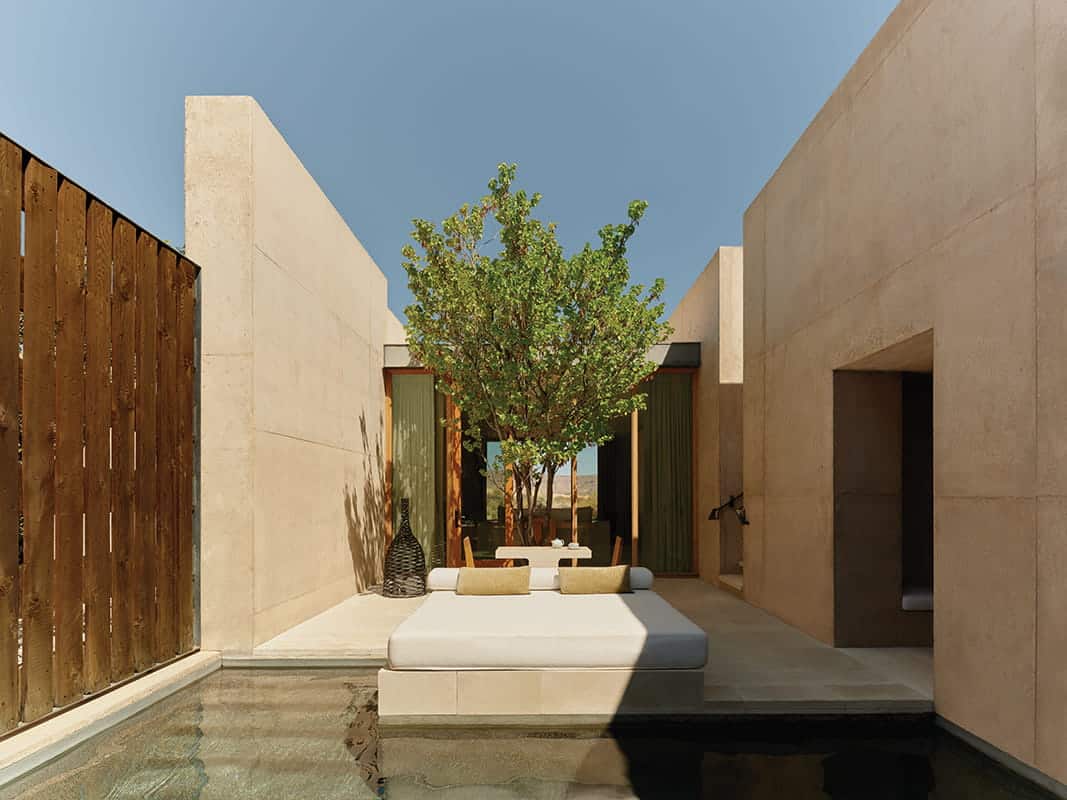
At the main Amangiri resort, the Mesa Pool Suites feature tranquil outdoor spaces that include private plunge pools.
Photo courtesy of CAMP SARIKA AT AMANGIRI
I rarely find it hard to craft a description of something I’ve experienced, but whatever words come next will surely not capture the awe I felt waking up to the sun-glowing mesas, stepped and rugged against an ombre blue sky. In the distance, a hot air balloon bobbed like a tiny beacon in the morning cold. I stepped outside. It was crisp and quiet, the desert winds marshalling thousand-year-old secrets across the rocky terrain. Out here, you brush up against wild things, ancient rituals, and a crackling sense that you’re never quite alone. There are stories embedded in the mesas, hoodoos, and slot canyons that imbue the area with a sense of serenity, the tantalizing pull of history and myth.
Amangiri doesn’t announce itself, but rather nestles confidently into the majesty of what’s already there: striated sandstone, silvery scrub, and a hot desert light that feels restorative. Part of the global Aman collective, the property is positioned on 900 acres of private land in Canyon Point, Utah, which sits in the “Grand Circle” region, providing access to a concentration of national parks—including Bryce Canyon, Zion, Arches, and the Grand Canyon—and nearby Lake Powell. The main resort, 34 suites and the Amangiri Spa, is designed around a striking swimming pool built to embrace the landscape. Here, 160-million-year-old sandstone rubs elbows with contemporary architecture and unmatched hospitality.
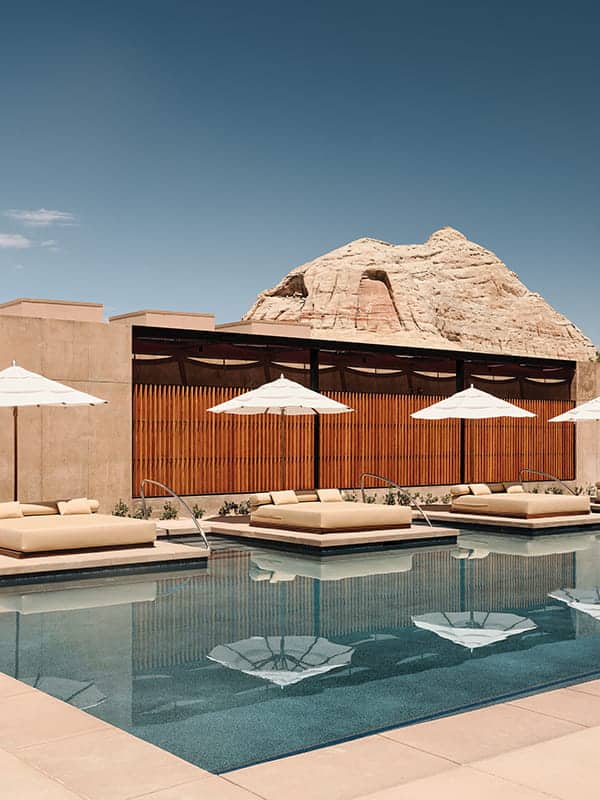
Big dipper. Camp Sarika main pool.
Photo courtesy of CAMP SARIKA AT AMANGIRI
Camp Sarika is an exclusive enclave with-in the already-elite destination; it sits just a five-minute golf cart ride away from the main resort. Comprising 10 tented pavilions, each with its own plunge pool, this section is all about privacy. The modern, minimal one- and two-bedroom accommodations blend with their surroundings and are positioned so that you can’t see your neighbor. Stocked with snacks and beverages, luxury bath products, and items you might need during your stay (hats, backpacks, flashlights), the tents come with a delightful turn-down service (the first night I returned to find my firepit lit and a waiting tray of s’mores ingredients). Meals are included, and can be eaten at Cam Sarika’s central lodge or Amangiri.
There seem to be two types of travelers that visit this property: Those who want to make the most of the resort proper, and those looking for adventure farther afield. For either group, the 25,000-square-foot Amangiri Spa is worthy of an entire afternoon. Indulge in traditional treatments such as massages and facials, then continue the downshift into relaxation by cycling through the water pavilion, which includes a steam room, sauna, cold plunge pool, and heated step pool. There is also a private jacuzzi big enough for two that looks out at a dramatic rock formation (no, you never get tired of seeing them), providing decompression for body and mind.
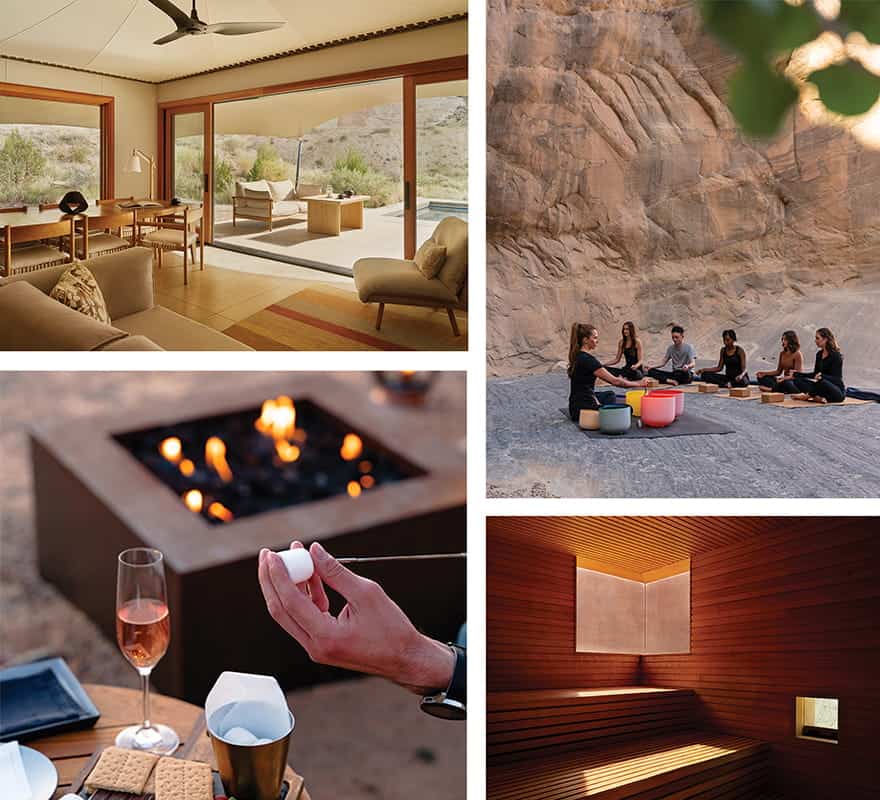
One-bedroom tented pavilion, firepit lit and a waiting tray of s’mores ingredients, yoga in the desert and a private jacuzzi are some of the indulgements at Camp Sarika.
Photos courtesy of CAMP SARIKA AT AMANGIRI
When it comes to adventure, Amangiri will meet you where you are—and, if you’re open to it, push you to a place you never thought (or only hoped) you could reach. For me, that happened while experiencing Via Ferrata for the first time. A combination of hiking and rock climbing, Via Ferrata (“iron road” in Italian) appeared during the First World War to aid troop movements in the Dolomite Mountains.
Led by guides from local outfitter Adventure Partners, we donned harnesses and helmets, clipped onto a safety cable, and spent the next three hours working through a course of fixed steel cables, ladders, and metal rungs anchored into the rock. There are two suspension bridge crossings—the grand finale spans a 450-foot-high gorge. Via Ferrata is not for anyone who is afraid of heights, which, luckily, I am not. What I am nervous about are activities I’ve never done before, which, in a metaphoric sense could point to me being afraid of the unknown. Climbing, something I never thought I would do, is such an in-the-moment activity that I didn’t have time to think about anything beyond where to place my feet or fasten my clip. Everything else fell away in a manner I hadn’t experienced in a long time. It was just me, the cool rock faces, hard work, and, at the end, a rewarding view that reminded me of my intricate connection within the tapestry of humanity.
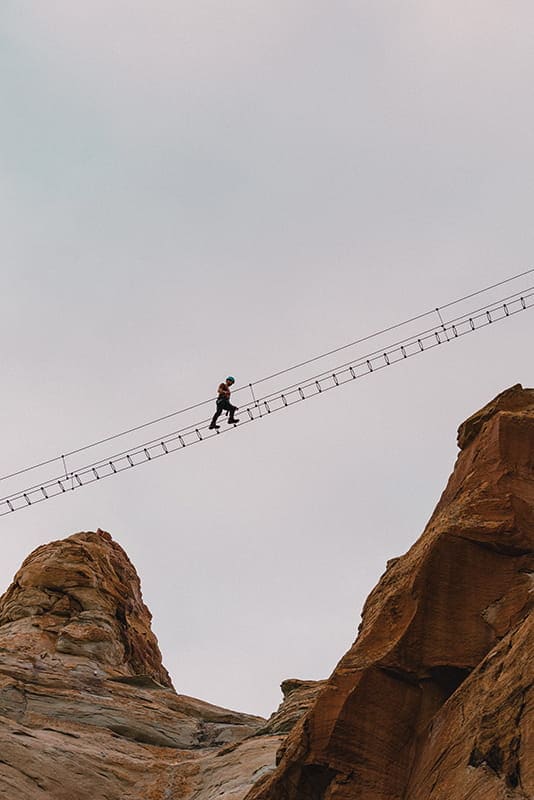
One of the activities offered at Amangiri is Via Ferrata, a guided climbing course of fixed steel cables, ladders, and rungs that takes participants across sets of bridges spanning some of the property’s vast canyons.
Photo courtesy of CAMP SARIKA AT AMANGIRI
“For me, this is the cathedral of life,” said one of our guides, J.J. McMahon, as we stood on the top of a mesa looking out onto miles of desert. “No matter what you believe in, everyone gets up here and feels something.”
If heights aren’t your thing, Amangiri offers a whole menu of desert excursions: Hiking on its 12 miles of trails (including a tour of Broken Arrow Cave, where you can see ancient Native American petroglyphs and artifacts), the aforementioned hot air balloons, helicopter rides to national parks, stargazing, ATV rides, and slot canyon tours led by a Navajo guide. Formed over millions of years as a result of water slowing eroding rock, the earthy red slot canyons are full of twists, curves, and nodes that, from the right angle, form a parade of shapes including human faces, bears, fish, an eagle, and other animals. Our tour was another instance of humans rubbing up against the edges of nature, history, and time: It’s hard to visit and not feel something profound. “You step in with your philosophy, your ethics, and you come out a better person,” our guide Eli said as we wound through the sandstone caverns. I don’t know if I’m any “better” than I was before my trip to Amangiri, but I can say that I came home deeply moved, with a stronger connection to the natural world than I had experienced in years.