



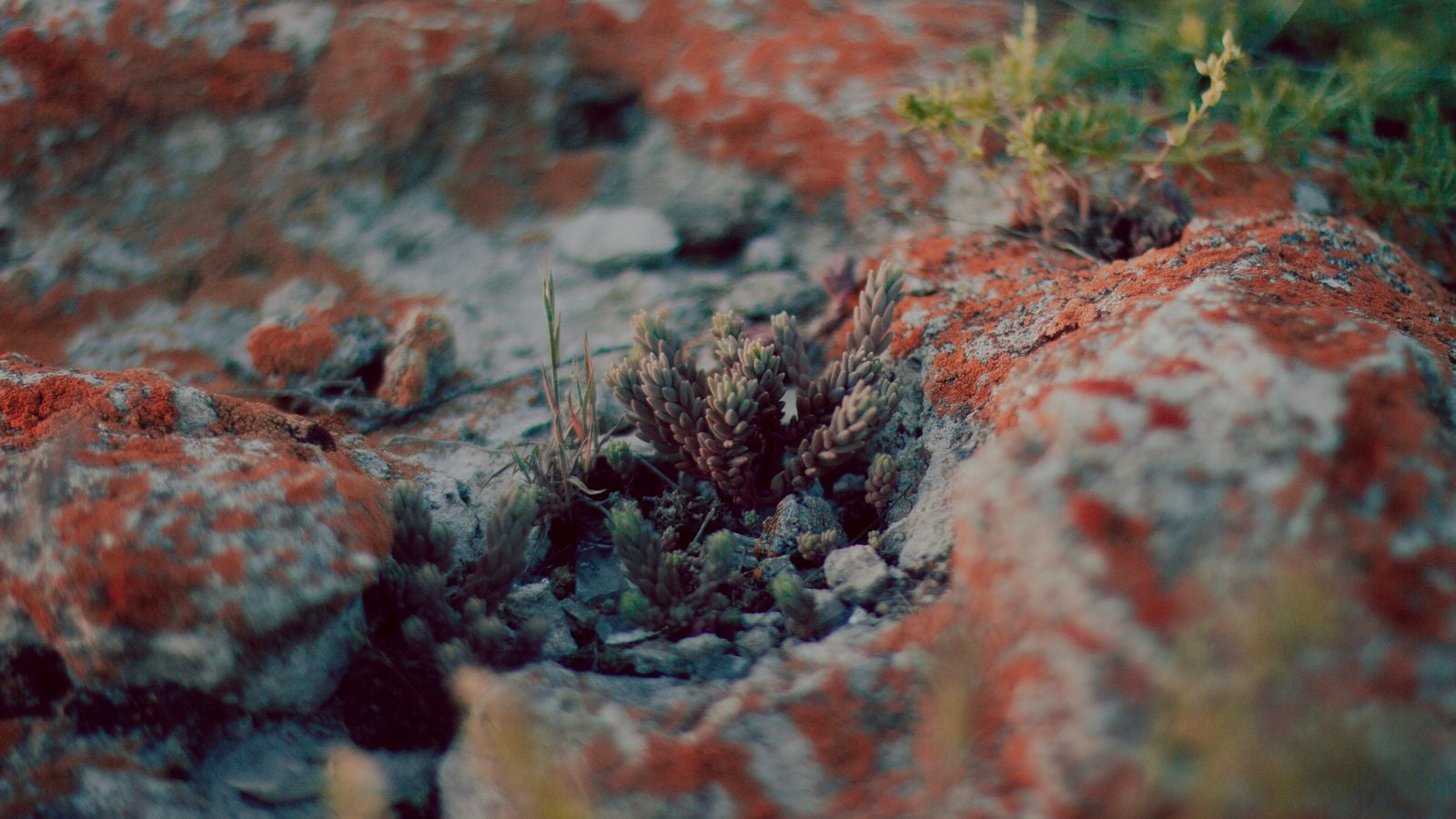
Some weather stations in the Atacama Desert of northern Chile have recorded no measurable rainfall for centuries. Not a drizzle. Not a passing shower. And yet, in the same terrain where the soil chemistry more closely resembles Mars than anything else on Earth, entire colonies of lichen cling to rocks and boulders, kept alive by a grey wall of Pacific fog that rolls in most mornings and dissolves by noon.
The fog is called camanchaca. It forms offshore, where the cold Humboldt Current chills the air above the sea into a thick low-lying cloud, then drifts inland until it collides with the coastal escarpment. On contact with rock, it condenses. Each drop is minute — but enough of them collect on lichen thalli, cactus spines, and spider silk to sustain a biosphere in a place that, by every conventional definition, should be sterile.
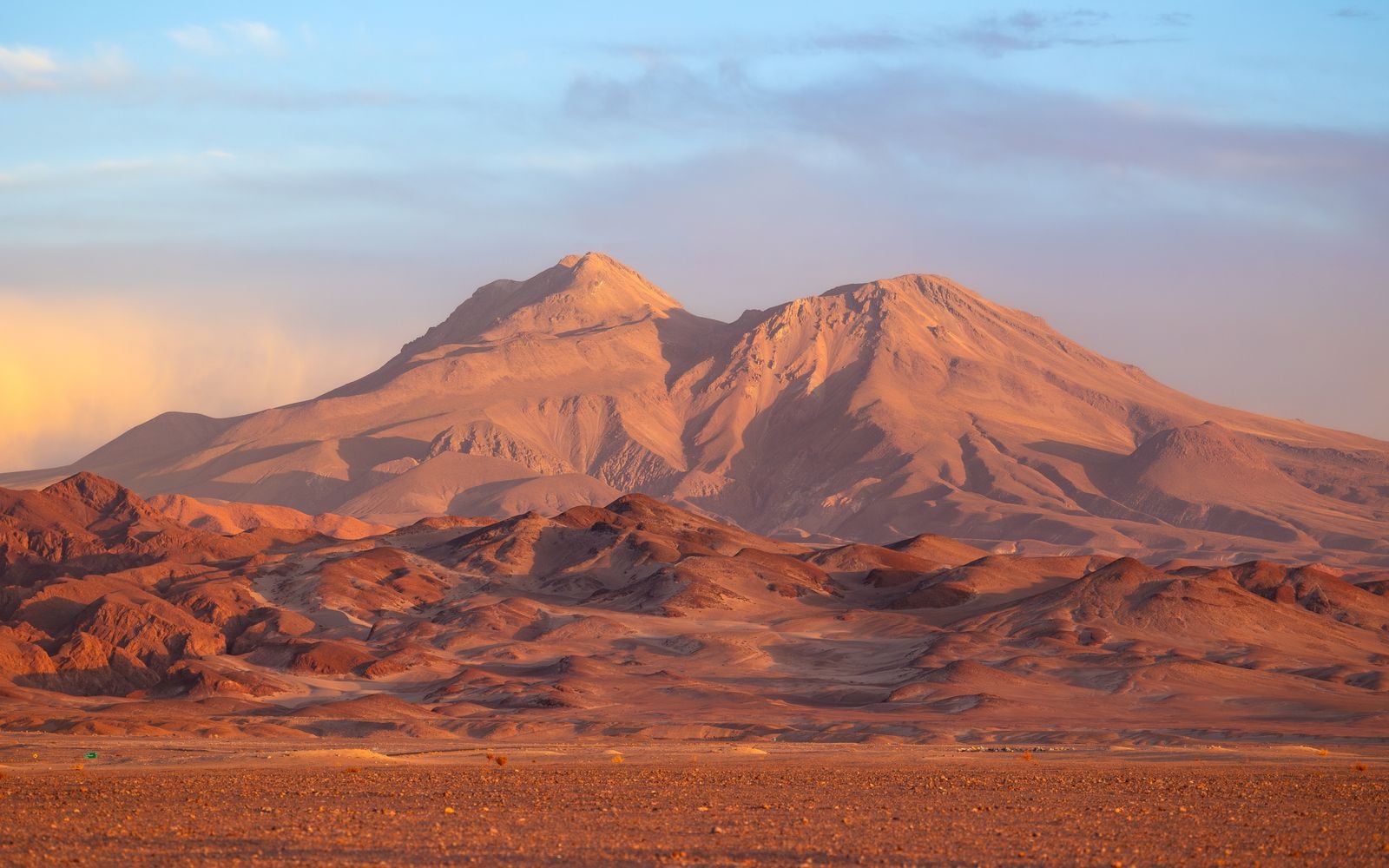
A desert drier than Mars in places
The Atacama stretches roughly 1,000 kilometres along the Pacific coast of Chile, wedged between the Andes to the east and the Chilean Coast Range to the west. Annual irradiance in the region exceeds 2,500 kWh per square metre, the highest solar radiation on the planet — one reason it hosts a substantial portion of Chile’s installed solar capacity, and one reason its rocks are baked, scoured, and stripped of almost every trace of organic matter.
Rainfall in the hyper-arid core averages less than one millimetre per year. Some stations near Yungay and Quillagua have not registered a rain event in the entire span of modern instrumental records. NASA scientists have used the region for decades as an analogue for the Martian surface, because the soil is so parched and so oxidised that it approaches the chemistry of the Viking landing sites.
Which is what makes the lichen story strange. Life exists here anyway.
What the fog carries
The camanchaca is not rain. It is a saturated marine cloud that hugs the coastal cliffs — the same band where lichen coverage on rock faces is often heaviest. Where the fog belt intersects the topography, it forms what ecologists call fog oases, or lomas, patches of unlikely green in a beige landscape.
Individual fog droplets are tiny, but they settle on any surface with sufficient texture — the ridged crusts of lichen, the pubescence of a Tillandsia leaf, the bristles of a candelabra cactus — and coalesce into films of water thin enough to be absorbed directly, without ever pooling on the ground. Lichens, being composite organisms of fungus and photosynthetic partner, can rehydrate from atmospheric moisture alone. They do not need soil water. They do not need rain. They need sufficient humidity for a few hours a day, and the camanchaca delivers exactly that.
Life in the soil, against expectation
The strangeness runs deeper than the lichen. An international team led by researchers at the University of Cologne’s Institute of Zoology has been documenting the soil biology of the Atacama for years as part of the Collaborative Research Centre 1211 “Earth – Evolution at the Dry Limit”. Their work, published in Nature Communications, showed that even in this landscape, tiny soil-dwelling nematodes persist across salt flats, sand dunes, river beds, and fog oases.
Dr Philipp Schiffer, one of the study’s authors, put it plainly: “Soils are important for the performance of an ecosystem, for example for carbon storage and nutrient supply. This is why understanding the organisms, i.e. not microbes, but multicellular animals, that live there is so important. Data on soils in extreme ecosystems such as the Atacama Desert is still scarce.”
Where fog and altitude produced more moisture, biodiversity climbed. Where salt content and UV radiation rose, food webs simplified into brittle chains.
The lichen as instrument
A lichen is, in effect, a slow-motion humidity gauge. Its growth rings can be measured, its isotopic composition sampled, its coverage mapped from satellites. In the Atacama, lichen colonies have been used as proxies to reconstruct the historical frequency of fog events, because their distribution maps almost perfectly onto the elevation band where the camanchaca reliably condenses.
Lichen species form dense grey-green mats on north-facing rocks. Some individual thalli are believed to be centuries old, growing at rates measured in fractions of a millimetre per year. They have survived while empires rose and fell, sustained entirely by mist.
Why the fog exists at all
The camanchaca is a product of a specific oceanographic accident. The Humboldt Current carries cold, nutrient-rich water up from Antarctic latitudes along the western edge of South America. Where that cold water meets warm subtropical air, condensation is inevitable. The trade winds push the resulting stratus cloud eastward until it slams into the Coast Range.
The same current that makes the desert dry — by suppressing convection and preventing storms from forming over the ocean — is the current that also, indirectly, keeps the fog belt alive. Silicon Canals has explored how these fog oases sustain species found nowhere else on Earth, endemic to a coastal band no more than a few kilometres wide.
Harvesting the fog
Local communities in the region figured out, decades ago, that the same trick used by the lichen could be scaled up. Fog collectors — vertical mesh nets strung between poles — intercept droplets from the passing camanchaca. On a good morning, a single square metre of mesh can yield several litres of clean water. Villages on the arid coastal margins have used systems like these to supplement drinking water, irrigate small vineyards, and support reforestation of native trees.
The engineering is almost embarrassingly simple. The physics is the same as lichen biology: give the fog a surface, and it gives you water back.
A Martian analogue with life
For planetary scientists, the Atacama has become one of the most closely studied stretches of ground on Earth. The soil chemistry, radiation environment, and desiccation levels closely resemble the surface of Mars, and NASA has repeatedly tested rovers and life-detection instruments here before sending them to another planet. A 2022 review published on arXiv by researchers at the University of Atacama noted that nearly 60 per cent of planetary science publications based on data from the Puna, Altiplano and Atacama regions included no local institutional partner — a bibliographic imbalance that Latin American scientists have been working to correct.
The relevance to Mars research is direct. If lichen can rehydrate from a few hours of fog contact on rock that never sees rain, then the search for extant microbial life on the Martian surface — where transient frost and thin atmospheric moisture do occur — takes on a different shape. The question stops being whether life needs liquid water, and starts being how briefly and how minimally life can survive on it.
The industrial neighbour
Nearby, on the same coastal plateau where lichen colonies drink fog, utility-scale solar farms have gone up. The Atacama has become a major solar hub, with facilities delivering power to the Chilean grid. A recent study from the Universidade de Vigo modelled how climate change might alter the region’s photovoltaic potential through 2060, and found that projected increases in surface air temperature would drop solar power output per square metre by roughly 1.23 per cent under a low-emissions pathway and 1.53 per cent under a high-emissions one — small numbers, but consequential across gigawatts of installed capacity.
The same drying trend that boosts solar irradiance stresses the fog belt. Warmer sea surface temperatures weaken the Humboldt-driven stratus deck. Fewer fog days mean less moisture on the rocks. Less moisture means slower-growing lichen, and in some places, no lichen at all.
How the lichen survives the sun
During the dry afternoon hours, when the fog has burned off and the desert sun is one of the harshest on the planet, the lichen desiccates completely. Its metabolism halts. Its cellular water content drops close to zero. It becomes, functionally, mineral — waiting.
Then the next morning’s fog arrives. The thallus rehydrates within minutes. Photosynthesis restarts. Cellular repair kicks in during the brief window of humidity, and by the time the sun climbs high enough to boil the moisture off the rock again, the lichen has banked another few hours of growth. Over a year, this might amount to a fraction of a millimetre. Over a century, a few centimetres of grey-green crust that has never touched rain.
The extremophile playbook is not unique to the Atacama. Silicon Canals has covered how tardigrades survive vacuum, radiation, and freezing by entering a glassy dehydrated state that pauses their biology until water returns. The lichen strategy is the same trick, played daily on a rock face in Chile.
The morning routine
Before dawn, the camanchaca forms a grey ceiling maybe 800 metres above the ocean. It creeps inland with the sea breeze, climbing the western slopes of the Coast Range. By the time the sun rises over the Andes, the fog has already begun to condense on every rough surface it can find — the northern faces of granite outcrops, the dead spikes of Copiapoa cacti, the vertical mesh nets of the water collectors, the crusted mats of lichen that have been waiting there, dry and dormant, since yesterday.
By ten o’clock the fog has lifted. The rocks steam briefly. Then they are hot, and dry, and silent again. The lichen has drunk. The desert, in its terms, has had its rain.